Adhering To The 'Replicon Model' The Sloppy Way
by Christoph
Sixty years ago Jacob, Brenner and Cuzin devised their 'Replicon Model', inspiring and useful guideline for replication research ever since. According to the model, a 'Replicon' is a genetic element replicated from a single 'Replicator' – replication origin, in modern terms – and replication is triggered by a positive trans-acting factor, the 'Initiator' (see Figure 1). One hallmark of the 'Replicon Model' was the postulation of a positive regulator: at the time of its publication gene regulation was mostly thought about in terms of negative regulation or repression, inspired by the seminal lac operon paradigm.
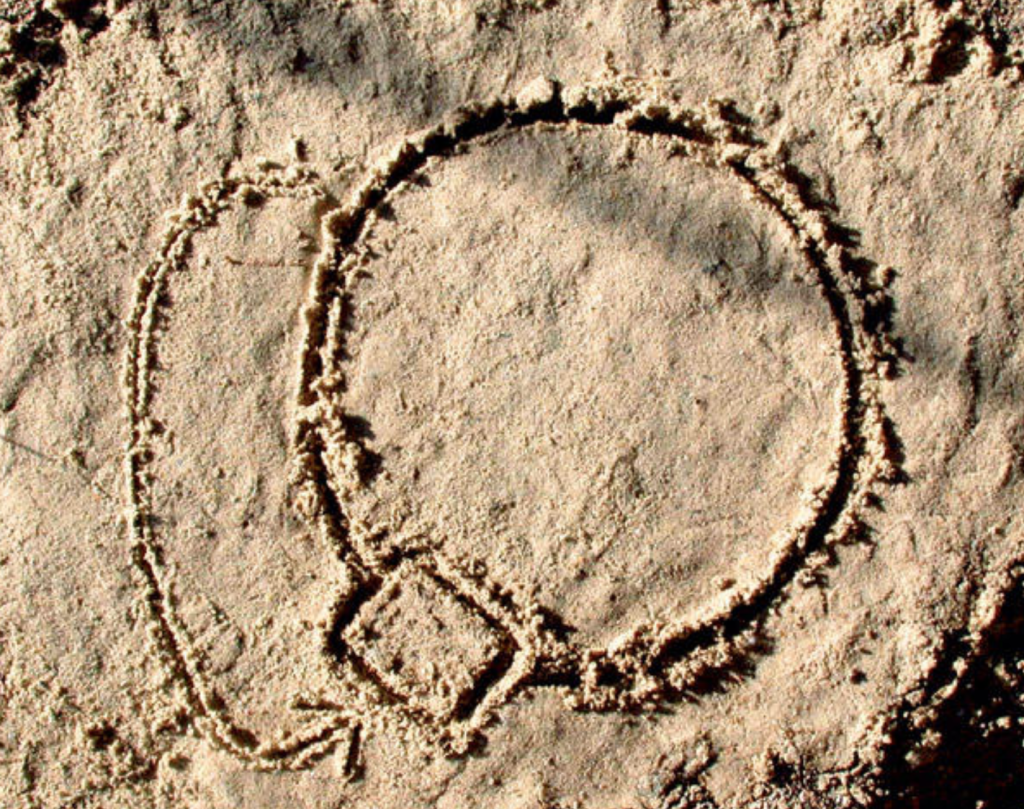
Figure 1. 'Circles in the Sand': A drawing in the sand of a replicon as presented in Jacob et al. (1963). The main circle represents the replicon, the square box represents the replicator, and the arrow indicates where the initiator protein is encoded, which, when synthesized, binds to the replicator (Figure provided by M. Méchali). Source
A Matter of Language
Many bacteria have a single chromosomal replication origin, oriC, which has been identified and studied in E. coli (Gammaproteobacteria), Bacillus subtilis (Firmicutes), Caulobactder crescentus (Alphaproteobacteria), Helicobacter pylori (Epsilonproteobateria), Mycobacterium tuberculosis and Streptomyces coelicolor (Actinobacteria), to name just some favored model organisms. The 'Initiator' in bacteria is the DnaA protein. (Almost) all sequenced bacterial genomes have dnaA genes and all DnaA proteins are homologs that belong to a distinct subclass of the AAA+ ATPases. (Almost) all bacteria employ a set of conserved replication factors for initiation, strand separation, priming, clamping, and discontinuous DNA synthesis. Despite this relative simplicity, the pre- and post-initiation mechanisms that ensure the 'once and only once' chromosome replication per cell cycle turned out to be not only intricate but astonishingly variable among the cases studied. Using a metaphor one might say that with respect to replication, all bacteria speak English, using the same grammar and syntax but each branch with a rather unique local dialect in their vocabulary. Just like someone from Inverness, Florida would face problems getting along in Inverness, Scotland.
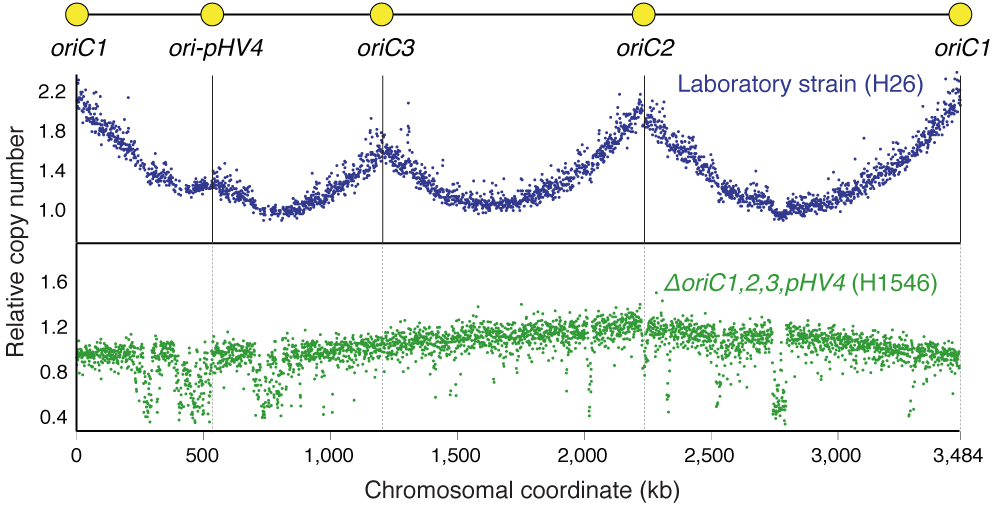
Figure 2. H. volcanii replication origins. Source
This is biology, so there are exceptions. Pseudomonas species (Gammaproteobacteria) have two functional oriCs, however they are located at a close distance to each other. Many of the insect endosymbiont bacteria with highly reduced genomes lack one or more genes of the replication machinery – including dnaA genes – and it remains to be figured out how they replicate their chromosomes. And there are (at least) two species of Fusobacteria that lack dnaA genes but have RepA-type plasmid initiator genes, intriguingly at the chromosomal position that is usually "occupied" by dnaA. So far, no gross contradictions to the 'Replicon Model'.
Sticking to the metaphor, archaea and eukarya speak French. The grammar and syntax of replication – initiation, strand separation, priming, clamping, discontinuous DNA synthesis – are fairly similar to those of the bacteria. On the other hand, they use a completely different vocabulary: the factors are functional homologs of their bacterial counterparts but belong to different protein families. The chromosome of Pyrococcus abyssi (Euryarchaeota) is replicated from a single oriC, whereas three different oriCs are used to replicate the single chromosome of Sulfolobus species (Crenarchaeota). Eukaria usually have a plethora of origins along their chromosomes. But here again no gross contradictions to the 'Replicon Model'.
If One Origin Is Good, Are Several Better?
Haloferax volcanii (Euryarchaeota, Halobacteria) sports several replication origins on its main chromosome, all of which have been mapped by Thorsten Allers' lab. For the aficionados: of other genetic and physical techniques, they used the traditional minichromosome approach, that is, determining whether a presumptive origin can drive the replication of a selectable origin-less plasmid. In their present study, these researchers asked to what extent each of these multiple origins contributes to chromosome replication. To this end, they turned DNA sequencing into an analytical tool.
This ingenious twist needs probably a brief explanation. In 'shotgun' DNA sequencing of genomes, chromosomal DNA – usually obtained from stationary cultures – is chopped down to bits and pieces that are then sequenced. The short reads are assembled to the full genome sequence by appropriate software. Plotting the number of reads for a given base vs. its genome position gives a rough measure for the 'sequencing depth', i.e. the reliability of the obtained data. If, however, chromosomal DNA is prepared and sequenced from an asynchronously growing culture, plotting the number of reads for a given base vs. its genome position indicates replication start points seen as peaks on a graph. The reason being that DNA fragments close to an active replication origin occur with higher frequency.
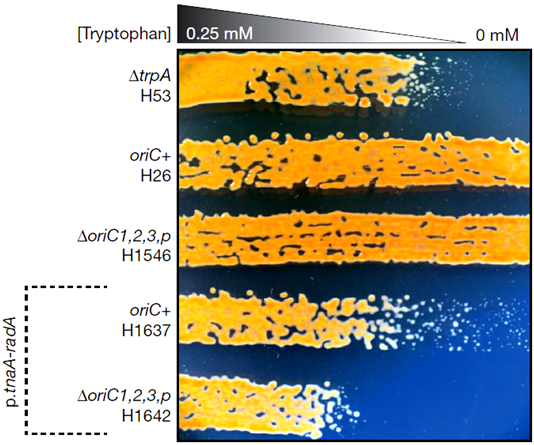
Figure 3. RadA recombinase is essential in an ΔoriC1,2,3,pHV4 mutant. radA was placed under control of the tryptophan-inducible PtnaA promoter, in oriC1 and ΔoriC1,2,3,pHV4 strains (H1637 and H1642). The former grows slowly in the absence of tryptophan whereas the latter is inviable. Absence of tryptophan does not affect the growth of oriC1 and ΔoriC1,2,3,pHV4 control strains (H26 and H1546); the ΔtrpA control strain (H53) is auxotrophic for tryptophan. Source
Detour: The principle here used of "counting gene copies" was devised early on for work confirming that bacterial chromosome replication is sequential, that is, it starts at a site we call origin and proceeds bidirectionally to a terminus. In 1963, Yoshikawa and Sueoka measured the number of copies of various genes in Bacillus subtilis using genetic transformation. They incidentally discovered that, when growing rapidly, bacteria undergo multifork replication to cope with the problem that cell division takes less time than replicating the chromosome.
All H. volcanii origins could thus be shown to contribute to chromosome replication albeit with differing efficacies (see Figure 2, upper part). In subsequent pairwise growth competition experiments, single origin deletion strains grew slower than the wild type parent but to some surprise, the deletion of two ore three origins resulted in strains that grew slightly better than the wild type! Indeed, a strain having all origins deleted grew ~7.5% better than the wild type (see Figure 3). Stranger things are happening here.
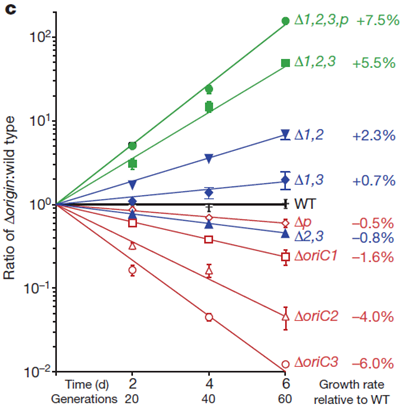
Figure 4. Pairwise growth competition assays comparing wild type (WT) and origin deletion strains. Source
In the strain whose origins had all been deleted, Allers and coworkers did not detect novel peaks, which would have suggested that silent origins had been activated. But they noticed a wider zone of copy number enrichment in the 2,250 kb region near the rrnB ribosomal RNA operon (see Figure 2, lower part). Since it is known that highly transcribed DNA is associated with elevated recombination, they assumed that D‑loops and R‑loops in the rrnB region could facilitate the initiation of replication much the same way as entertained by phage T4 (see p. 335 in Weigel and Seitz (2006)). To confirm this, they placed the recombination gene radA under control of a tryptophan-inducible promoter. In the absence of tryptophan, when this promoter is tightly repressed, origin-less cells failed to grow, an effect rescued by the addition of tryptophan (see Figure 4).
Simple It Isn't
The observation that the rate of growth correlates inversely with the activity of remaining origins suggested to these researchers that recombination-dependent replication is more efficient than origin-dependent replication, but the former has a lower affinity for the replicative helicase MCM, which is rate-limiting due to its low abundance. Why then is there origin-dependent replication at all? These workers hypothesize that origin-dependent replication allows for a tighter regulation of the coordination between replication and chromosome segregation. This would be crucial in bacteria like E. coli, which under fast growth conditions need to maintain a fixed ploidy in overlapping cell cycles. H. volcanii, however, is highly polyploid with ~20 chromosomes per cell, which allows for a stochastic distribution of chromosomes to daughter cells. The authors envision the possibility that an ancestral, origin-lacking H. volcanii chromosome was virtually 'hijacked' by related selfish replicons containing a replication origin and an initiator gene in close vicinity. With time, the coupling of replication to segregation evolved to ensure their propagation. This at the cost of a slightly reduced growth fitness as observed for the "wild type" in comparison to the origin-deletion mutants.
To come full circle: already before the onset of the new millennium, Tokio Kogoma showed that in E. coli chromosome replication is possible in sdrA mutants lacking dnaA or oriC or both. The lack of RNase H in the sdrA mutant leads to a prolonged half life of mRNA·DNA hybrids and the recombinational repair of such structures is sufficient to sustain chromosome replication. Kogoma called this process constitutive stable DNA replication (cSDR). As was found by Hawkins et al. for H. volcanii radA mutants lacking the origins, cSDR in E. coli is crucially dependent on the RecA recombination protein. It appears that the "three Rs" (replication, repair, recombination) are nicely intertwined mechanistically in the archaea too and – most likely – also in the eukarya. A final remark: the 'Replicon Model' does not preclude the existence of such intricate "backup systems".
Reference
Hawkins M, Malla S, Blythe MJ, Nieduszynski CA, Allers T. (2013). Accelerated growth in the absence of DNA replication origins. Nature, 503 (7477), 544–547 PMID 24185008