
Talmudic Question #115

Is global warming likely to result in a significant net increase, decrease, or no substantial change in the microbial biomass on Earth?
Is global warming likely to result in a significant net increase, decrease, or no substantial change in the microbial biomass on Earth?

by Merry Youle — A recent paper by Edgar and colleagues captured my attention with a new twist on how to combat antibiotic resistance: Our overall goal in this study is to provide a proof of principle for a genetic system that is able to restore drug sensitivity to drug-resistant pathogens residing on…
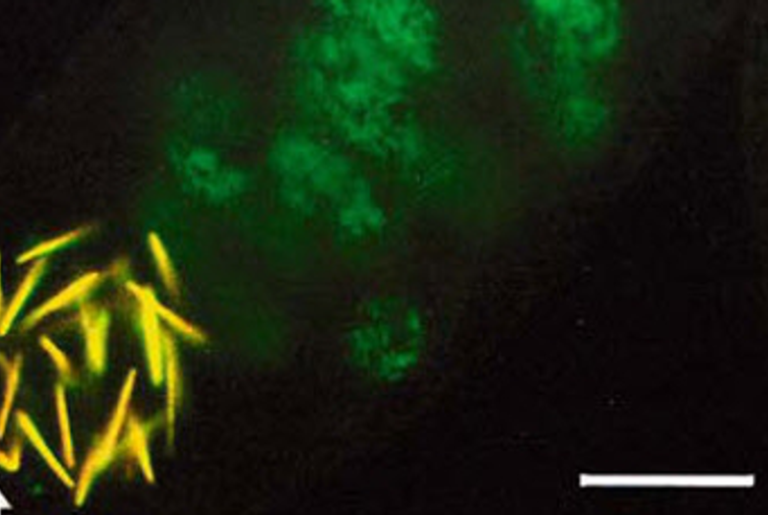
by Merry — From the bacterial point of view, a paramecium is a microcosm offering several tempting niches for colonization. When you collect a paramecium from nature, it's likely to have hundreds – even thousands – of bacterial endosymbionts on board, in different locations. Some will likely be in the...

by Fred Neidhardt — The following is a personal account of the beginning years of what is now called proteomics. Odd that I, almost a Luddite, should be writing about the origin of a field initiated by a dramatic technical advance; I tend to avoid complex new scientific instruments and techniques. As a graduate student...

Pictures Considered #17 by Elio — Described as the "Most Beautiful Experiment In Biology" the demonstration by Meselson and Stahl that DNA replicates semiconservatively is one of the major landmarks in the genesis of modern biology. And indeed it is most pleasing, both visually and cerebrally...

by Patrick Keeling — Microsporidia are a diverse group of obligate intracellular eukaryotic parasites. There are approximately 1,300 formally described species in 160 genera, but this certainly represents a tiny fraction of the real diversity because most potential host lineages...

by Daniel P. Haeusser — Each spring the Department of Microbiology and Molecular Genetics at UT Houston goes on an annual departmental retreat to Camp Allen for science, recreation, and festivities. This year, before the ever-popular 'social time' that extends into the wee hours, the first years finished 'Science Fun Time' with a PowerPoint presentation of 'If Microbes Could Tweet'...