Mi­crobes En­er­gize the Brain 

Note­wor­thy

Hu­mans are dif­fer­ent from other pri­mates due to a com­bi­na­tion of fea­tures. Prime among these is the large brain size that en­dows us with a dis­tinct ca­pac­ity for com­plex rea­son­ing, plan­ning, and de­ci­sion-mak­ing. But a large brain size de­mands a lot of en­ergy. Could mem­bers of the gut mi­cro­biota have co-evolved to sup­port this high de­mand for glu­cose in our brains? 

This is the ques­tion ad­dressed in a re­cent study by re­searchers from var­i­ous in­sti­tu­tions in the US. The gut mi­cro­biota is known, af­ter all, to in­flu­ence brain ac­tiv­ity by its con­nec­tion via the gut-brain axis. To un­der­stand whether pri­mate brain evo­lu­tion could have been in­flu­enced by mi­crobes in the gut, the au­thors in­oc­u­lated germ-free mice with the gut mi­cro­biota from three pri­mate species with dif­fer­ent brain sizes – hu­mans, macaques, and squir­rel mon­keys. In a pre­vi­ous study, this group had shown that trans­fer­ring gut mi­crobes from pri­mates into mice in­flu­enced host en­ergy me­tab­o­lism.

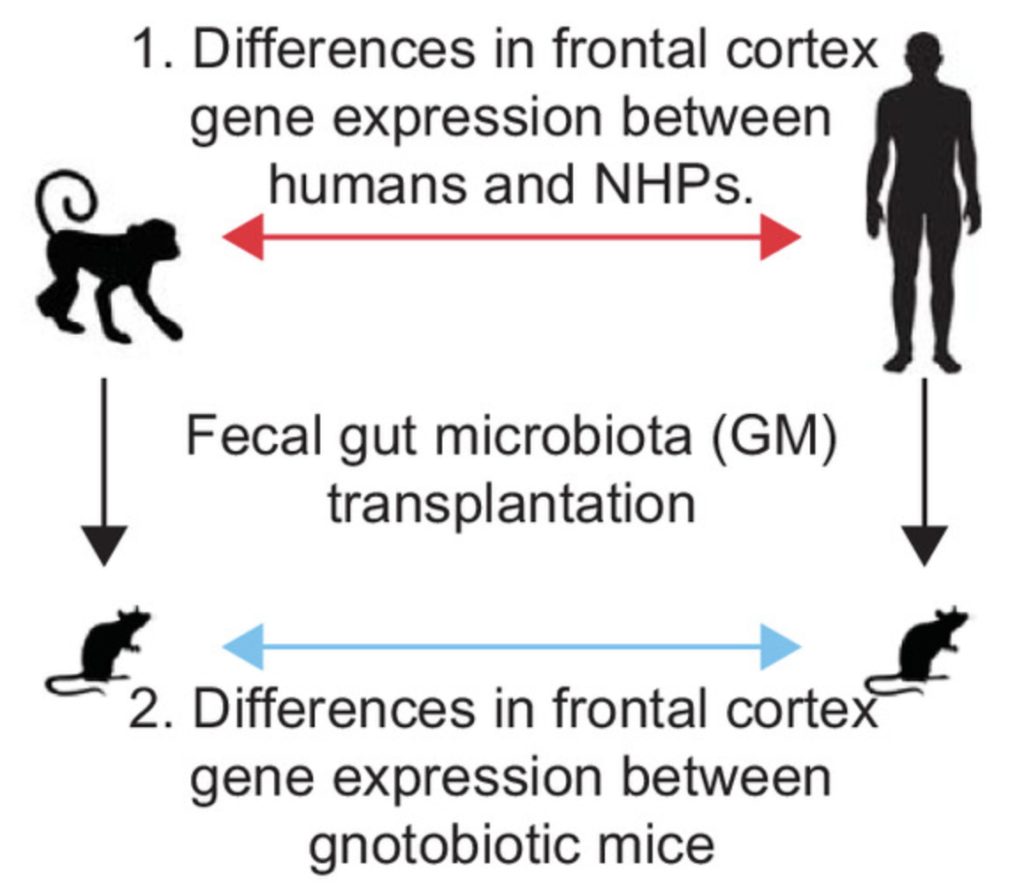
Hu­man and mon­key gut mi­cro­biota (GM) drive di­ver­gent gene ex­pres­sion in mouse brains. Car­toons and ar­rows sum­ma­rize ex­per­i­ments and analy­ses re­ported in the study. Dou­ble-headed ar­rows rep­re­sent dif­fer­en­tial gene ex­pres­sion be­tween host groups, in­clud­ing hu­mans, non-hu­man pri­mates (NHPs), and germ-free (gno­to­bi­otic) mice. Sin­gle-headed ar­rows rep­re­sent fe­cal-mi­cro­biota trans­plan­ta­tion. Source. Fron­tispiece: Hu­man and macaque brains com­pared, mod­i­fied from source.

In this new study, the con­nec­tion be­tween gut mi­crobes and the brain be­came ev­i­dent. Their ap­proach in­volved the analy­sis of gene ex­pres­sion in the frontal cor­tex, the part of the brain re­spon­si­ble for high-level cog­ni­tive func­tions, such as de­ci­sion-mak­ing, plan­ning, and  prob­lem-solv­ing. Frontal cor­tex gene ex­pres­sion pat­terns in mice brains with trans­planted mi­cro­biota looked sim­i­lar to those in the orig­i­nal pri­mate hosts. But even more in­ter­est­ing was the fact that the hu­man gut mi­cro­biota in­creased the ex­pres­sion of genes as­so­ci­ated with en­ergy pro­duc­tion and use in the brain, and down­reg­u­lated some genes in­volved in neu­rode­vel­op­men­tal dis­or­ders. 

Al­though this study was lim­ited to sam­ples from just three pri­mate species, it does sug­gest that gut mi­crobes can rewire the brain. The ob­served ef­fects also hint at a pos­si­ble co-evo­lu­tion of gut mi­crobes to sup­port the en­er­getic de­mands of larger brains, an in­trigu­ing hy­poth­e­sis that will need fur­ther test­ing.


We'd be de­lighted to hear from you! You can com­ment be­low, send us an email or reach us via Bluesky or Mastodon. Please sub­scribe to get email no­ti­fi­ca­tions of our new posts.

Other Posts

  • Biofilms by In­sect En­dosym­bionts

    by Janie — From a mi­cro­bial per­spec­tive, in­sect me­ta­mor­pho­sis is a trea­cher­ous bu­si­ness. The trans­for­ma­tion from lit­tle earth­bound craw­ler to lapis-blue flier is a fla­shy eye-cat­cher, but the change is more than skin-deep. Deep with­in the lar­va, the con­tents of the gut are emp­tied, in­tes­ti­nal cells wi­ther away by auto­phagy and apo­pto­sis, and the ca­vi­ty is re-up­­hol­ster­ed with di­vi­ding stem cells...

  • Geobac­ter: Mi­cro­bial Su­per­hero

    by Suzanne Win­ter — If the power of Su­per­man resided solely in his su­per­nat­ural abil­i­ties, then Bruce Wayne's Bat­man would never have been able to com­pete on his level. But when the other fac­tors that su­per­heroes de­pend upon are ac­counted for — side­kicks, span­dex, sar­casm — both Su­per­man and Bat­man can claim suc­cess in the world of do-good­ery…

  • Faster than a Speed­ing Bolt: Myco­plasma Walk This Way

    by Daniel P. Haeusser — Many prokary­otes move ac­tively in liq­uid (swim) or on moist solid sur­faces (swarm and glide) to­ward or away from a stim­u­lus, such as a nu­tri­ent, light, or oxy­gen. Not sur­pris­ingly, prokary­otes have evolved nu­mer­ous means of lo­co­mo­tion built around dis­tinct mol­e­c­u­lar mech­a­nisms…

  • By Chance and Ne­ces­sity...

    ...The Role of the Cy­toskele­ton in the Gen­e­sis of Eu­kary­otes by Daniel P. Haeusser — One of the most ex­cit­ing and en­dur­ing ob­scu­ri­ties of bi­ol­ogy lies in the early stages of the evo­lu­tion of "our" eu­kary­otic cells (Fig­ure 1). The en­dosym­bi­otic the­ory ac­counts well for the present ex­is­tence of the mi­to­chon­dr­ial and chloro­plast or­ganelles of eu­kary­otes. Al­though there is ev­i­dence for present day in­ter-bac­te­r­ial en­dosym­bio­sis...

  • A Snip­pet: Who In­vented Agri­cul­ture, the Ants or the Bees?

    by Elio — Agri­cul­ture was in­vented at the time of the di­nosaurs, long be­fore there was any­thing re­sem­bling a pri­mate on earth. Take the ex­am­ple of the leaf cut­ting ants. For about 50 mil­lion years, they have been har­vest­ing plant ma­te­r­ial, bring­ing it to their nest, chew­ing it up, and us­ing the chewate to grow fungi, which is what they eat...

  • When it's too cold to grow

    by Roberto — I be­gan think­ing about the cold weather in Bos­ton while I swam in an open wa­ter com­pe­ti­tion off the coast of Car­ta­ge­na de In­dias in Co­lom­bia's Carib­bean coast last week­end. Then my thoughts drift­ed to bac­te­ria swim­ming in col­der and col­der wa­ters. And then the ques­tion: ...

Subscribe
Notify of
0 Comments
Oldest
Newest Most Voted