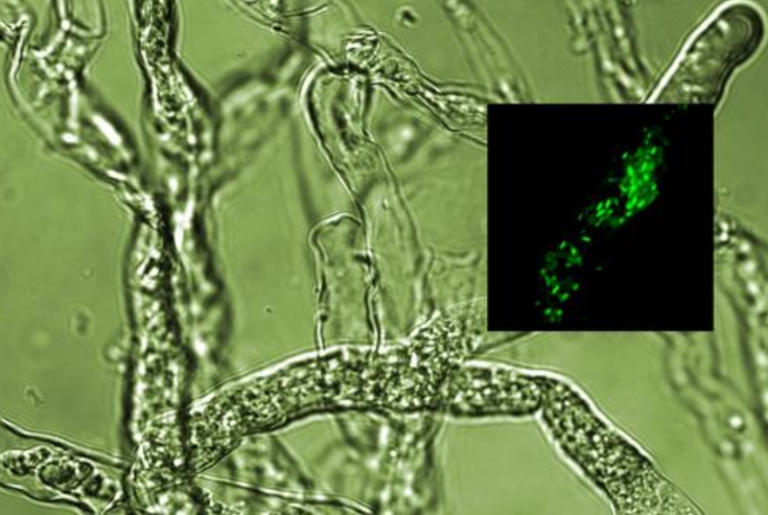
A Most Lively Virus – and an Addendum
We re-post this wonderful piece by Merry from nearly twelve years ago and add a brief account of an exciting new development on the topic of archaeal viruses. We know Merry, who had an inordinate fondness for bacteriophages, would have loved to write about it!
by Merry (†) and the STC team
Morphologically speaking, the viruses of mesophilic and moderately thermophilic bacteria and archaea are a dull bunch. Of 5,100 surveyed, 97% are ho-hum head-and-tail phages – icosahedral heads with helical tails. The remainder were tailless icosahedra or filaments, except for two spindle-shaped oddballs. If you'd like more structural excitement, best to go virus hunting in geothermally-heated aquatic environments above 80 ºC – the hot springs, mud holes, and deep-sea hydrothermal vents – and be prepared to be astonished.
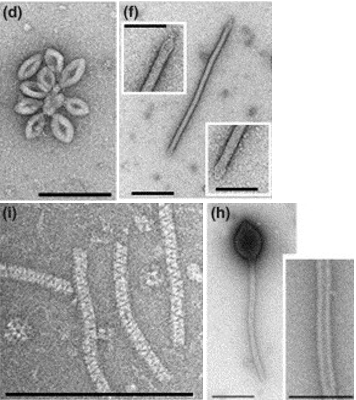
TEMs of a variety of viruses and virus-like particles observed in a single enrichment culture established from a sample collected at a Yellowstone hot acidic spring (85°C, pH 1.5–2.0). Bar = 200 nm (100 nm for insets). Source
Here the statistics are reversed. Only 6% resemble typical head-and-tail phages; another 6% are tailless icosahedrons; about two-thirds are filamentous, rod-shaped, or spindle-shaped; the rest are truly unique. The oddest ones are viruses of hyperthermophilic Crenarchaeota of the genera Sulfolobus, Acidianus, Pyrobaculum and Thermoproteus. About two dozen of these have been isolated and characterized, calling for the creation of seven new viral families to house them. All have dsDNA genomes, some linear and some circular. Almost all eschew host lysis, opting instead for a stable lysogenic relationship. Maybe life outside is just a little too tough.
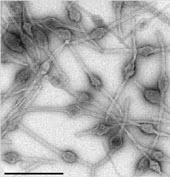
TEM of ATV virions in an enriched sample taken from acidic hot springs in Pozzuoli/IT (pH 1.5, 85–93ºC). Source
Here's one particularly fascinating example isolated in 2005 from an acidic hot spring (85–93ºC; pH 1.5) at Pozzuoli, Italy. Enrichment cultures contained unusual football-shaped virus-like particles with tails of varying lengths at each end. (The researchers describe them as "lemon-shaped," but lemons, at least in Hawaii, feel no obligation to resemble the Sunkist stereotype in either shape or color. "Football-shaped" isn't perfect either; footballs in some parts of the world are round.) These strange particles behave like respectable viruses, replicating in cells of the archaeon Acidianus convivator. This virus, the Acidianus two-tailed virus (ATV), has a family all to itself: the Bicaudaviridae (two-tailed viruses). Average length end-to-end for particles with fully developed tails is 744 nm.
Temperature matters to these viruses. When they infect at 85ºC, the optimum temperature for their host, they lysogenize. When the lysogens are experimentally subjected to a 75ºC "cold shock," the virus goes lytic, lysing the cells and releasing abundant virions four days later.
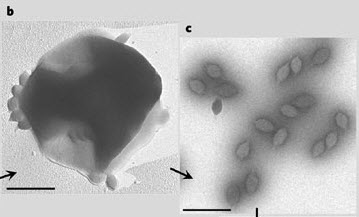
b TEM showing extrusion of football-shaped ATV virions from an A. convivator cell. c newly released virions. Bar = 0.5 µm. Source
If you are wondering how a bunch of three-quarters-of-a-micron-long virions are accommodated within the host cell prior to lysis, the answer is that they are not. The virions emerge as footballs; the tails form afterwards. This striking transformation does not require cell contact, an exogenous energy source, or co-factors, and as such is unique within the known viral world. A few other viruses undergo limited structural changes upon adsorption to a host cell or during budding from one, but this marked activity of ATV virions is host-independent, and a lively exception to our definition of virions as inert packages.
Why two tails? Why such long tails? The researchers note that ATV is the only virus of an acidophilic hyperthermophile known to lyse its host, albeit only under stress conditions. Thus, unlike those that stay indoors, ATV is confronted with a hostile environment where host cells are sparse. The tails triple their length, greatly increasing their chances of quickly bumping into a potential host cell.
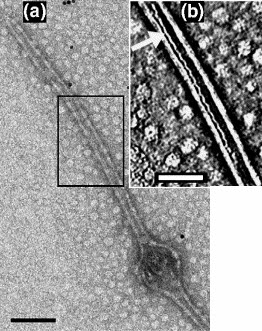
ATV virion. (a) TEM. (b) Three-dimensional reconstruction by electron tomography of the tail region shown in the inset. Arrow = internal 2 nm filament. Bar = 100 nm in (a), 50 nm in (b). Source
How the tails are formed remains a mystery. The process is temperature dependent. Tailless newborn particles can be held at 4ºC for several months, and still sprout no tails. At 75ºC, they grow tails, but very slowly, taking ~8 days. Given their preferred 85ºC they complete the job in less than an hour. In the process, the particles shrink to about half their original volume (even allowing for the volume of the tails.)
Addendum
The world of archaeal viruses continues to provide us with remarkable new biology. The recent paper by Junfeng Liu and colleagues describes how infection of the archaeon Sulfolobus islandicus by the non-lytic lemon-shaped virus STSV2 leads to dramatic changes in cell morphology. The virus interferes with the host's cell cycle, arresting it in S phase. Infection also represses transcription of the genes encoding the cell division machinery. Consequently, infected cells grow dramatically larger, reaching volumes 8,000-fold greater than uninfected cells. And instead of dividing by binary fission, these giant cells begin to reproduce through asymmetric division. By budding, much like yeast cells! If reinfected, these newborn cells also become giants. But there's a twist. If the host has a CRSIPR-Cas system, the giant cells acquire virus-derived spacers and terminating the spread of the virus. It is simply amazing how this archaeal virus manipulates the cell to convert it into a giant virion-producing factory!
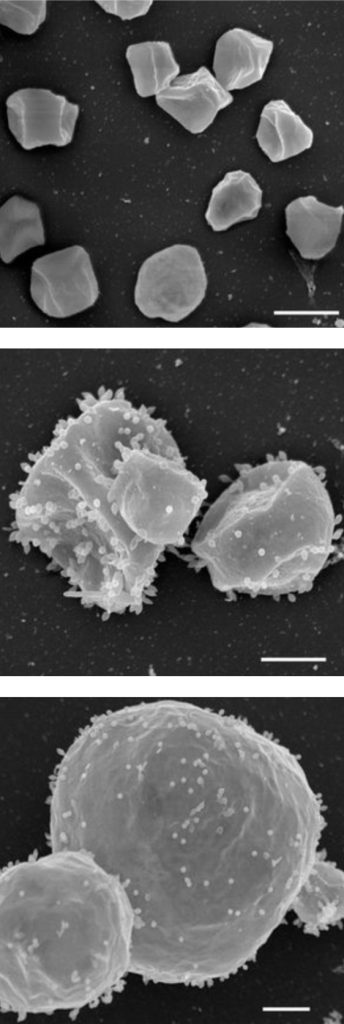
Virus-Induced Cell Gigantism. Top: uninfected cells. Middle: 1 day post infection. Bottom: 6 days post infection. Scale bar = 1 µm. Adapted from Source
References
Häring M, Vestergaard G, Rachel R, Chen L, Garrett RA, Prangishvili D. 2005. Virology: independent virus development outside a host. Nature, 436 (7054), 1101–1102. PMID 16121167
Liu J, Cvirkaite-Krupovic V, Baquero DP, Yang Y, Zhang Q, Yulong Shen Y, Krupovic M. 2021. Virus-induced cell gigantism and asymmetric cell division in archaea. Proc Natl Acad Sci USA, 118 (15), e2022578118. PMID 33782110
Prangishvili D, Vestergaard G, Häring M, Aramayo R, Basta T, Rachel R, & Garrett RA. 2006. Structural and genomic properties of the hyperthermophilic archaeal virus ATV with an extracellular stage of the reproductive cycle. J Mol Biol, 359 (5), 1203–1216. PMID 16677670