
A Glimpse Into the World of Metagenomics
This commentary was submitted to us in response to our post, Fine Reading: Metagenomics, published on October 16, 2008. The article entitled Metagenomics that recently appeared in Nature provides interesting insights into how metagenomicists appear to view microbes and the field of microbial ecology. What are some of the assumptions that are being made, based on the information given in this article?
by Donald A. Klein
Metagenomic approaches apparently are assumed to be the only way to study microbes in nature. It is asserted that, due to the limitations of cultivation-based approaches (the "cultivation bottleneck"), we have been ignorant of their [microbes']existence. My suggestion? An effective and direct means of establishing the existence of most microbes would be to use a microscope. Today, microscopy, especially when combined with staining, enzymatic, immunological, and molecular techniques, provides unique windows into morphological, physiological, molecular, and immunological characteristics of microbes as they exist in situ.

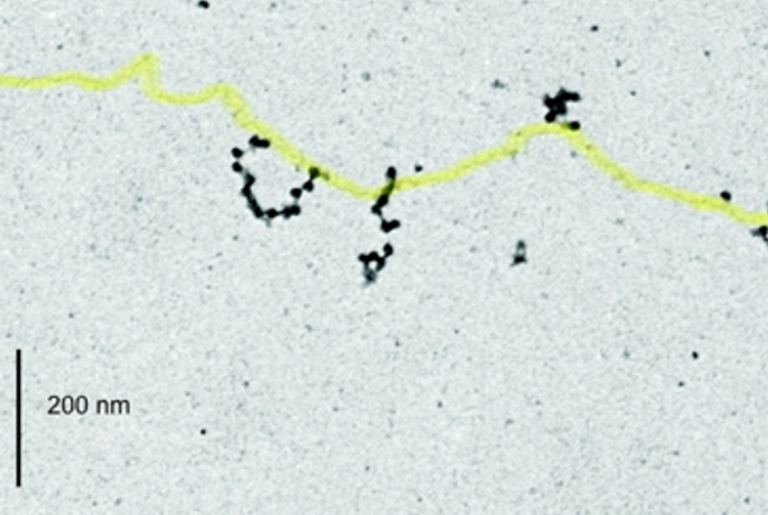
In situ activity of filamentous fungi in soil is assessed using fluorescein diacetate (FDA) staining. In this free hyphal unit, only the FDA-positive hyphal regions contain active cytoplasm. Hyphal diameter = ~3–5 μm.
As an example from my own work, we have sought to assess in situ active filamentous fungi in soils. The comparison of FDA-active (fluorescein diacetate-active) hyphal lengths with total hyphal lengths provides an estimate of the relative active fungal hyphal presence, important for characterizing these indeterminate filamentous fungi and their responses in various ecosystems. Microscopy-based approaches are central to microbial ecology, the study of in situ microbial interactions with their biotic and abiotic environments.
What does it mean to state that metagenomic approaches can be used to study microbial communities? "Microbial" includes bacteria, archaea, fungi, algae, and protozoa, as well as the acellular viruses, viroids, and prions. More problematic is the use here of the word "community." Based on its etymology, to be part of a community, an organism must be active and interacting in situ. It simply is not appropriate to assume that all microbes in an environment (active, inactive, dead) are part of the "community."
The authors suggest that metagenomics using bulk-extracted nucleic acids can provide information on the genome sequences of a community of organisms inhabiting a common environment. However, when using bulk extraction-based approaches, one has no idea of the source(s) of the nucleic acids/gene sequences that are being studied. It is not known if the recovered sequences are derived from active microbes, or even from microbes. How to solve this problem? Be sure the nucleic acids are derived from microbial assemblages that can be documented to be active in situ, as in a recent study of Alvinella bacterial episymbionts. Furthermore, as discussed by Kowalchuk and colleagues, amplification technologies provide access to microbial genomes at the level of a single microbial cell, which presents the possibility of examining microbial community genomes and activities one cell at a time. This enables one to assess genetic microheterogeneity at the level of the individual in situ active microbe.
The paper notes that a strength of the metagenomic approach is its potential for serendipitous discovery. Indeed, this strength is most clearly demonstrated when the discovered genes (such as those for archaeal ammonium oxidation and proteorhodopsins) can then be linked to organisms found in specific environments.
An overall assessment? The field of metagenomics can provide new and exciting views of microbes and their ecological interactions. The challenge is to link this metagenomic information to microbes that are active in situ. With this linkage, the metagenomic approach will more effectively fulfill its potential for providing new and truly exciting information concerning microbial ecology, i.e., the study of in situ active microbes and their interactions with their biotic and abiotic environments.

Donald A. Klein is a professor in the Department of Microbiology, Immunology, and Pathology, College of Veterinary Medicine and Biomedical Sciences, Colorado State University. A more detailed version of Don's views was published in the December, 2007, issue of ASM's Microbe magazine.



I agree strongly that the metagenomic approach can be interp[eted over-confidently in the study of complex communities. The points are well made. However, I think one should add that the spectre on "uncultivatability" should not deter attempts to enrich or further cultivate the posessor of an unusual but physiologically relatable microbe because the sequence has given clues as where one might start to ring the changes in providing possible conditions. There should be appreciation of the advice by Howard Gest: The microbe is growing in its environment where there are suitable conditions for growth and these conditions have to be discovered.
For a metagenomic approach, is it possible to obtain the non-culturable microbial flora in diseased plant leaves sample excluding the plant genomic DNA extraction?