
Talmudic Question #15

Why are only prokaryotes known to carry out biological nitrogen fixation?
Why are only prokaryotes known to carry out biological nitrogen fixation?
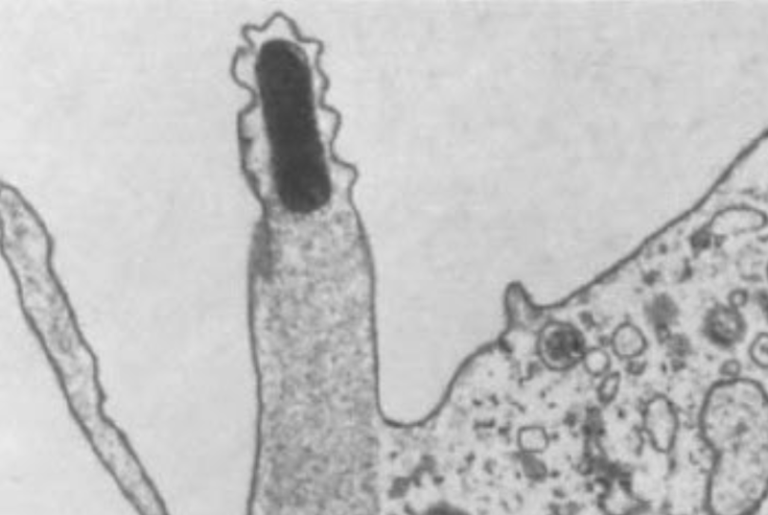
New Links Revealed By Intracellular Pathogens by Elio — Life inside cells of the immune system presents a special challenge to pathogenic bacteria. Some are killed after being taken up, others survive. One favorite mechanism used by Shigella, Listeria, and Rickettsia, among others, is to escape from the phagocytic vacuole into the cytoplasm. This avoids the action of enzymes…

by Veronica W. Rowlett — Predator-prey relationships exist all over the world of living things, from microbes to animals and humans. In defense against predators, animal prey use varied strategies such as hiding from, distracting, escaping, or fighting predators. Humans build walls and ramparts to protect themselves within cities from potential animal or human aggressors. But how do bacteria defend themselves...

Methanogenesis is characteristic of Archaea (and, according to some, plants as well). Why don't bacteria make methane? (Courtesy of David Lipson).

by Elio — Small things are not being considered here. Au contraire, I'm reporting on the largest fungus known, if by 'fungus' you mean the fruiting body of the organism. The reason for making this distinction is that a fungal mycelium can reach humongous proportions. The hyphae of a kind of oyster mushroom…

by Elio — In July, I attended the 2016 Gordon Research Conference on Microbial Stress. This is an august meeting with 2 decades to its name. The subjects presented were broader than the name of the meeting suggests and included many aspects of microbial physiology and genetics, touching even on ecology and evolution. "Stress," especially in the world of...

by Elio — Here's a bird that thinks it's a ruminant. Or, speaking science, ruminants may have coevolved their singular way to digest plant material with a bird. I am talking about the hoatzin, a tropical pheasant-sized or, in honor of the day, turkey-sized bird of Central and South America that ferments in its crop the leaves it eats.
It seems to me that there are two possibilities. (An aside, was the early earth rich or poor in available N? It seems likely that it was rich in it, but it's not my area)
1) Microbes evolved this function early in evolutionary time, and formed the basis for other organisms to use biologically fixed N — this, along with inorganic processes, provided sufficient N for other life. Other organisms that evolved found biological N to be a non-limiting resource. (perhaps Nitrogenase evolved in an anoxic world, so the restriction on O2 was not an issue?)
2) Microbes evolved this late, in a competition for niche space, utilizing their adaptability to create a space for themselves to live. Other organisms lack the capacity to develop this specialized function (energy intensive, requires anoxia, removal of H2 byproduct), or found it more economical to co-opt microbial N fixation.
Microscopically, organisms acquire nutrients "one at a time"; separate CNPS sources and a separate Energy source are plausible. Macroscopically, plants stand out as acquiring nutrients separately. They've co-opted microbial N‑fixation.
Along these lines, is the symbiosome a prelude to an legume N‑fixing endosymbiont (a nitroplast, or some more pleasant name).
A bit of a rambling comment, since I'm supposed to be writing an exam 🙂
The simple answer is that amateur karyotes just don't have the stuff.
The more complex answer (the Talmud never settles for one answer) might be, in part, that, in fact, eukaryotes DO have the ability to fix nitrogen — by forming symbiotic associations with prokaryotes that have the enzymes to do it with...which is the strategy eukaryotes have used to do most everything they do, from aerobic respiration to photosynthesis. Any more questions?
Reb Ben
It seems that nitrogen fixation was invented just once in 4 billion years. No new ways to do it have been found by prokaryotes or eukaryotes since then.
It may not be possible to re-invent it in the presence of oxygen.