
Getting CRISPR
by Merry
When you're outnumbered five or ten to one, strategy counts. Bacteria and archaea are master strategists, thriving despite the omnipresent hordes of phage. For some time, it has been known that prokaryotic cells have ploys for blocking phage adsorption, preventing DNA injection, recognizing and cleaving the incoming DNA, and otherwise aborting the infection. Recently, another potent – and likely very ancient – mechanism of defense has been discovered.
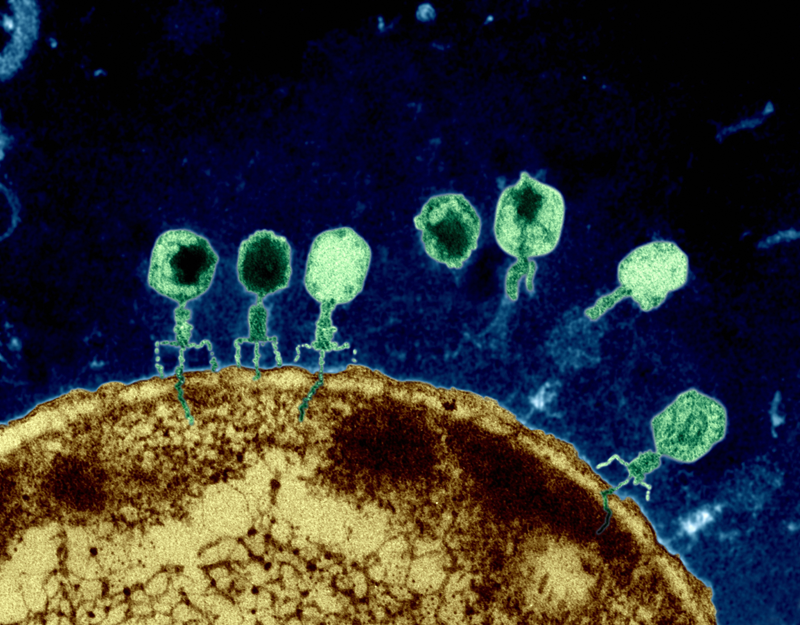
Phages on the surface of an Escherichia coli cell deliver genetic material into the bacterium. © Eye of Science
In 1987, researchers reported finding that the E. coli genome contains something unanticipated, namely clusters of regularly interspaced short palindromic repeats, now known as CRISPRs. Since then, CRISPRs have been found all over – in 40% of all sequenced bacterial genomes, 90% of archaeal genomes. A CRISPR is an array made up of a series of direct repeats alternating with short intervening regions ("spacers"). The number of CRISPR arrays varies from organism to organism, as does the number of repeats. The repeats within each array are almost always identical; the intervening regions vary. Strong interest in CRISPRs was aroused when it was found that the sequences of some spacers matched sequences in known phages or plasmids. (For an excellent recent review, click here.)

Diagram of a CRISPR array. CAS genes are CRISPR-associated genes that encode the CRISPR enzymatic machinery. Source
Recently, Barrangou and colleagues found that CRISPR systems can provide resistance to phage infection in Streptococcus thermophilus. They had good reasons for choosing S. thermophilus, as this is the workhorse of the dairy industry, used widely for the production of cheese and yogurt. Since phage infection has been an ongoing problem for that industry, numerous phage-resistant strains are available, as well as genome sequences for more than a dozen infecting phages. These researchers found that resistant strains have additional intervening regions (spacers) in one of their CRISPR arrays. Next step: they challenged the phage-sensitive strain with either of two phages, or with both simultaneously, and recovered nine new phage-resistant mutants. In every case the mutant had acquired between one and four new intervening regions. Startlingly, the sequences of those regions were derived from the phage genomes.
When the sequence of an intervening region was identical to a phage sequence, the mutant was resistant to infection by that phage, and resistance increased with the number of such regions acquired. If even just one nucleotide did not match, resistance was lost. Thus it is the intervening regions that provide the specificity – the business end of the arrays. One can think of this phenomenon as a case of inherited adaptive immunity. CRISPRs add to the variety of ways that we see genomes changing in a regulated manner. Chromosomal DNA, once the staid repository of protein-encoding information, has evolved into "the dynamic genome."

Playground seesaw in Poland. Credit: Mohylek
This fast-paced arms race between phage and prokaryote host continues. The acquisition of new intervening regions by potential host cells is rapid (with the oldest ones being deleted to keep the size of CRISPR arrays in bounds). Entire CRISPR systems have been acquired by horizontal gene transfer. Phage evade the new defense by mutations (either nucleotide substitutions or deletions) in the corresponding sequences, thus trumping that particular CRISPR sequence. The advantage seesaws back and forth. You might well be thinking that phage, also being terrific strategists, have evolved some ways to inactivate the host's CRISPR system. Indeed, the first suggestive observations have already been reported.
The intriguing story, which is just starting to be deciphered, is how CRISPRs work, i.e., how their information is transmitted. Although the exact mechanism by which they confer immunity is not known, there is evidence suggesting a gene-silencing mechanism similar to the RNAi pathway in eukaryotes. Since many of the intervening regions are homologous to host chromosomal DNA, CRISPR might also play a role in regulating chromosomal genes.
CRISPRs may have a number of possible applications, including bacterial strain typing (spoligotyping), antiviral therapy, and microbial gene silencing. The words small interfering RNAs (siRNAs) are being heard throughout the microbial lands.
Another fine post, Elio! Keep up the good work! Posts like this are invaluable for people like me who aren't involved with science but like to keep up with what's going on.
I paged back to the top and saw the that the author of this post is Merry rather than Elio — a cohort, perhaps?
Larry,
First, let me say how glad we are that you find this blog of value to you. Thanks also for pointing out that the author of the post on CRISPR is Merry, not me. You ask if she is a cohort, and the answer is yes, in the very best sense of the term. We collaborate in all aspects of this blog, including the choice of material, the editing, and writing. She lives on the Big Island of Hawaii and I in San Diego, but our intellectual proximity belies the geographic distance. But beyond that, we share an abiding love for "the small things."
Very interesting post, Merry. I was just working with phages in an undergraduate microbiology lab and I have to say, to me this is a fascinating area of biology. You and Elio have such a great writing style to help newbies like me (oh and thousands of undergrads) understand microbiology. Keep up the great work!
Also, Prof. Elio Schaechter, I know this is long overdue, but thanks for the lecture you gave for my class at UCSD (BIMM 120 with Pogliano). It was great! After some discussion with my peers, we all came to agreement that we wish you would still be willing to teach at UCSD. Your ability to capture our attention and interest in the subject is a gift few educators have.
Ah. I almost forgot. Thank's for signing my friend's textbook. In retrospect, I wish I had bought my own book for you to sign, though I admit microbiology did not interest me at the time. Amazing how things change. You and professor Pogliano have made this one of my favorite classes at UCSD. That's saying a lot, considering that I'm graduating next quarter.
Hi I am sajib Chakraborty , MS student at the Dhaka university,Bangladesh. I am also working with the CRISPR in Vibrio Cholerae genome by using bioinformatics.
It's a nice and very informative blog. I loved it very much. So studies suggest that RNAi is not restricted in higher aminals only. Prokariots also have this system.But I think the RNAi mechanism in prokaryot and eukaryot has evolved differently throughout the course of evolution. Although there are some concerved common domains between the prokaryotic CAS proteins and eukaryotic dicer or other RNAi proteins but these CAS proteins lac some domains (like Paz domain) that are present in eukaryotic RNAi pathway proteins.
Amazing post! did you find anything more about this lately? I am working with CRISPRs in Enterococcus hirae.