
Complex Simplicity
We translate and offer a post from the Spanish blog Esos Pequeños Bichitos (Those Small Bugs).
by Miguel Vicente
The textbooks we used in the 20th century described bacterial division with one term, binary fission, implying a simple process. Nothing could be farther from the truth. Today we know that more than a dozen proteins are employed to make the division septum in Escherichia coli. They assemble in a complex sequence and all are needed. In the absence of any one, subsequent assembly is not possible and division cannot take place. Before this machinery can be assembled, an initiator protein, FtsZ, becomes localized in the middle of the cell, where it makes a constriction ring.
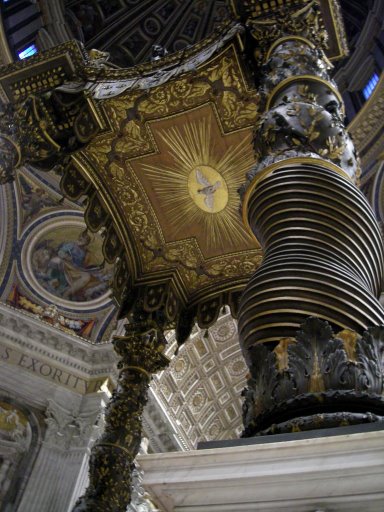
Bernini's baldachin (aka canopy of state) in the Vatican's Basilica of Saint Peter. The helical columns remind us of the helical rails that transport proteins along the membrane of bacterial cells. Credit: Thiago.
The Search for the Center
There are at least two mechanisms that ensure the precise location of FtsZ. One is that this protein does not function in the vicinity of the nucleoid (termed "nucleoid occlusion" by Conrad Woldringh.) The other way is independent of the nucleoid and relies on the local concentration of an FtsZ inhibitor called MinC (a mechanism proposed by Larry Rothfield.)
Likewise, there are two mechanisms for the establishment of this MinC gradient, with the greatest concentration being found at the cell poles. MinC is associated with a membrane-bound protein, MinD. The MinCD complex oscillates from pole to pole in E. coli with the help of a third protein, MinE. In Bacillus subtilis, on the other hand, the MinCD complex is attracted to a protein called DivIVA that is localized at the cell pole.
Riding the Rails
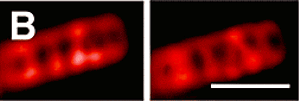
Two images of the same B. subtilis cell with stained lipid helices taken at different focal depths. Source
In either case, how do these proteins manage to travel the length of the cell? Investigators from the Slovak Academy of Sciences and the University of York found that lipids in the membrane in B. subtilis make helical "rails" that bind MinD and its associated MinC. To detect these rails, the authors used fluorescent dyes that preferentially stain the particular phospholipid to which MinD binds.
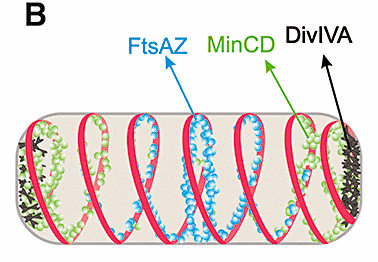
B. subtilis division proteins distributed along the cell membrane by the helical "rails." Source
There are other proteins that form helical bundles along the interior of the membrane of rod-shaped bacteria. One of them, MreB, is responsible for maintenance of the cell's shape and cells become rounded in its absence. Even FtsZ and its accompanying protein FtsA, two proteins needed for making the division septum, make intracellular helices.

OK, I definitely have a lot of catch-up reading to do.
I've only recently dove into the science side of the blogosphere, but with all the bacterial fun stuff permeating recently, I'm wondering if sooner or later we're going to start to see if there is a truly elegant intracellular structure for bacteria.
I mean, there is but I'm thinking something that rivals the Eukaryotic method of compartmentalization without dropping down walls.
This is still not the general view outside of bacteriology, as far as I can tell (true?), but I personally thing there is something rather intricate there.
I assume the trick in conceiving of its nature will involve breaking through the "can you have true organization without compartmentalization?" issue.