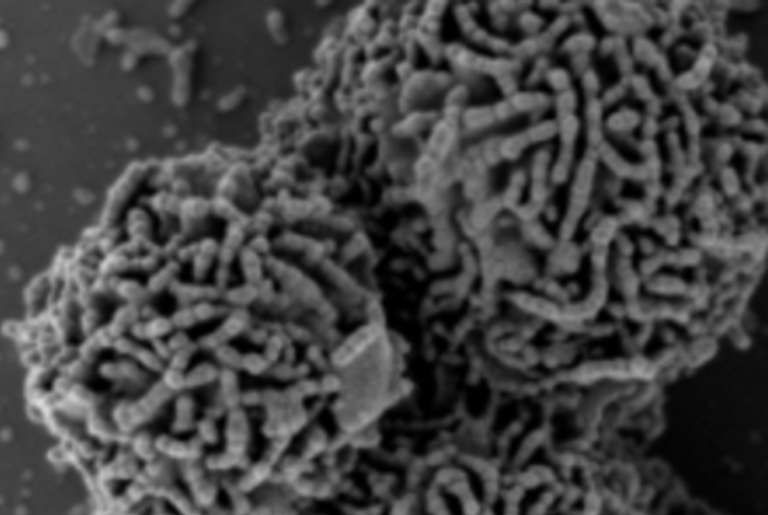
Small predators that could save our lives
We have translated and post here with kind permission from the author Jéssica Gil Serna a piece from her blog La Ventana Microscópica that you can read here in the original Spanish.
by Jéssica Gil Serna
The world of predatory bacteria is a true reflection of the David versus Goliath story. A small cell needs to kill its large prey to ensure its own survival. This is the case of bacteria of the genus Bdellovibrio whose importance has been highlighted in recent years as a possible alternative to defeat antibiotic-resistant superbugs.
The German Heinz Stolp discovered the predatory bacteria of the genus Bdellovibrio in the 1960s in a rather serendipitous way. He was trying to isolate bacteriophage viruses affecting the plant pathogenic bacterium Pseudomonas syringae from soil samples. At one point, he ran out of the filters he usually used in his experiments and resorted to ones with a larger pore size. After a day of incubation, he found no clear plaques on his media plates characteristic of bacteriophage infection. However, instead of throwing them away as the protocol said, he left the plates in the lab for a couple more days. And it was at this point that he made his breakthrough discovery when he observed unexpected areas of lysis on his plates. Subsequent studies revealed that this effect was related to the presence of small predatory bacteria that parasitized the Pseudomonas cells until they were wiped out. As has happened in great discoveries throughout history, chance had a lot to do in this case. If he had not used those larger pore filters, the small predators would not have been able to pass through them, and if he had not left the plates longer, lysis would not have occurred.

Figure 1. (A) Original photograph of the article where the genus Bdellovibrio is described for the first time. The lysis zones produced by the predatory bacterium in a Pseudomonas culture can be clearly seen. (B) Lytic action of Bdellovibrio baeteriovorus, strain Bd. 109, on Escherichia coli B, after streaking a mixture of parasites and host bacteria on nutrient agar. Source. Frontispiece: Bdellovibrio, the cannibal bacteria with the potential to save lives Source
These bacteria were named Bdellovibrio because of their comma shape (vibrio) and because they resembled leeches (βδέλλα in Greek) when absorbing the contents of their prey. Currently, it is known that they can parasitize different types of bacteria but always Gram-negatives. The most studied species so far is Bdellovibrio bacterivorous (see here in STC), which is surprising for having a huge genome for how small it is. Its chromosome of 3.7 million base pairs encodes more than 3500 proteins that help it carry out its complex life cycle.
This predatory bacterium is free-living and thanks to its flagellum it moves until it finds a poor and defenseless prey. Once it makes contact, it is able to form a pore in its wall through which it penetrates inside and stays in the periplasmic space, located between the wall and the inner and outer membranes of the parasitized bacterium. There it loses its flagellum and begins to produce enzymes that damage the cell wall of the prey. It feeds on the nutrients that are released and begins to elongate, forming a spiral structure in which it replicates its genetic material many times. When it notices that the host bacterium can no longer cope, it divides into multiple daughter cells that once again begin their free life on the outside. These progeny bacteria already have their own flagellum and will go in search of new prey to attack.

Figure 2. Life cycle of predatory Bdellovibrio bacteria. CC-BY-SA‑4.0 Burn12121212
Predatory bacteria of the genus Bdellovibrio have been found in numerous habitats such as soil, fresh and salt water, and even as part of our microbiota. They are believed to be essential for controlling population size and thus the balance of ecosystems. But beyond their interest for being such a curious type of bacteria, research is now focusing on their possible therapeutic potential as "living antibiotics." Antibiotic resistance is a serious problem today and it is essential to develop unconventional therapies to cure infections caused by these superbugs. It has been shown that predatory bacteria cannot affect eukaryotic cells, so our tissues would be safe from attack. Therefore, different research groups are studying whether the administration of predatory bacteria could be an option, and encouraging results are being obtained. Because of the mode of action they present, prey resistance is a fact that could be considered unlikely and so far no strain has been described that can effectively evade infection.

Figure 3. Transmission electron microscopy image in which Pseudomonas cells are being attacked by predatory bacteria of the genus Bdellovibrio. Journal of Plant Pathology. 2015. 97 :405–417
In addition, some pathogenic bacteria live in microbial communities protected by an extracellular matrix called biofilm. Antibiotics penetrate these structures with great difficulty, which considerably complicates their access to pathogens. However, predatory bacteria can easily penetrate this matrix and reach their prey, which is another advantage of their application as "live antibiotics." This ability to penetrate complex matrices is of particular interest for the use of predatory bacteria in the treatment of patients with cystic fibrosis. Persistent, life-threatening respiratory infections caused, for example, by Pseudomonas or Burkholderia are very common in these patients. The local application of some genera of predatory bacteria could be effective in preventing these infections since it has been shown that they can effectively colonize the lungs and even form part of the pulmonary microbiota in these patients.
Despite their undoubted potential, the use of predator bacteria has not yet been approved, as some doubts remain to be solved, such as how best to administer them or whether our immune system would respond by attacking them. However, let's hope that in the near future they will be a real treatment option and that our little predators will be able to defeat superbugs as David defeated Goliath.
Recommended reading
Dwidar M, Monnappa AK, Mitchell RJ. 2012. The dual probiotic and antibiotic nature of Bdellovibrio bacteriovorus. BMB Reports 45 :71−78. DOI: 10.5483/bmbrep.2012.45.2.71
Cavallo FM, Jordana L, Friedrich AW, Glasner C, van Dijl JM. 2021. Bdellovibrio bacteriovorus: a potential 'living antibiotic' to control bacterial pathogens. Critical Reviews in Microbiology 47 :630−646. DOI: 10.1080/1040841x.2021.1908956