Take a Deep Breath of... Methane
by Christoph
If you were faced with the task of preparing a lecture series on "general bacterial physiology", you could easily choose Pseudomonas aeruginosa as your companion, your model organism, to cover (almost) every topic. Yet, when it comes to metabolic versatility, you could also think of Rhodopseudomonas palustris as an alternative. This Aphaproteobacterium of the Order Rhizobiales – despite its similar name it is only distantly related to P. aeruginosa (Gammaproteobacteria) – can flexibly switch among any of four metabolic 'life styles': photoautotrophic, photoheterotrophic, chemoautotrophic, and chemoheterotrophic. Plus, it can fix atmospheric nitrogen. That's hard to swallow...
A whiff of physiology

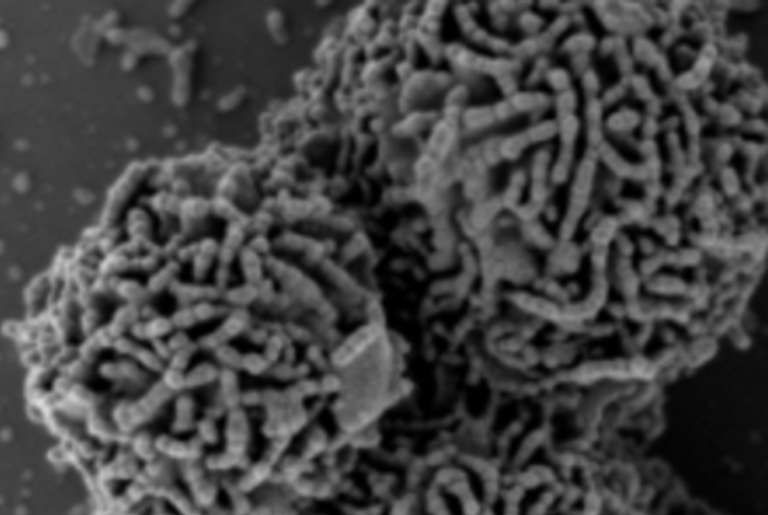
Figure 1. Rhodopseudomonas palustris streaked on a plate that was incubated anaerobically. Source. Frontpage: EM of a bunch of R. palustris cells. Note that the grayscale of the original electron micrograph was converted to shades of red (no scale given) Source
Let me dilute these highly-concentrated pills into more drinkable sips by citing what Carrie Harwood's lab at the University of Washington, Seattle, WA, tells about this bacterium on their webpage:
Rhodopseudomonas palustris is a purple facultatively photosynthetic bacterium that lives in environments like the surface layers of water logged soils that tend to straddle oxic to anoxic transition zones. When R. palustris is exposed to atmospheric levels of oxygen, it oxidizes carbon compounds such as acetate for carbon and energy by aerobic respiration. When it is exposed to oxygen depleted (2 – 6% O2) or anaerobic conditions, R. palustris turns a characteristic deep purple color (Figure 1) as it synthesizes the light absorbing pigments (bacteriochlorophyll) needed to carry out photosynthesis. It generates ATP anaerobically and under low oxygen tensions by anoxygenic photosynthesis, which does not generate O2 and is not obligatorily linked to CO2 fixation. R. palustris prefers to use organic compounds for cell carbon when it is generating ATP by anoxygenic photosynthesis. This growth mode is referred to as photoheterotrophic. Under microaerobic or anaerobic growth conditions R. palustris can use nitrogen gas (N2) from the atmosphere as a sole nitrogen source for growth by the process of nitrogen fixation, generating hydrogen (H2) along with ammonium (NH3/NH4+) as products.
From Nitrogen fixation to Methane production
Nitrogen fixation is performed in Archaea and Bacteria by three homologous, multi-subunit enzyme complexes, whose structures and biochemistry are well understood, and which differ in their requirements for two metal cofactors each: molybdenum (Mo) and iron (Fe) ions for 'Mo nitrogenases', vanadium (V) and iron ions for 'V nitrogenases', and iron ions for 'Fe-only nitrogenases'. Genes for all three nitrogenases are encoded in the R. palustris genome (major components: NifD, VnfD, and AnfD, respectively). As enzymes, nitrogenases are notoriously "promiscuous" in the reduction reactions that they catalyse. Mo and V nitrogenases, for example, reduce N2 to NH3/NH4+ but can, as by-products, reduce carbon monoxide (CO), and "concatenate" methylene intermediates (–CH2–) to various hydrocarbon products in vitro. In a very recent study from the Harwood lab, Zheng et al. demonstrated that purified R. palustris Fe-only nitrogenase AnfDGKH (precisely: reconstituted with the AnfH subunit of A. vinelandii, which is highly homologous to the cognate AnfH) produced small but detectable amounts of methane (CH4) in addition to NH3/NH4+ and H2 (see here). The production of H2 by nitrogenases in this reaction has long been a riddle for biochemists yet it was partially solved recently (and as it is not connected to CH4 production I won't go into the details; if you're interested you can learn more here).

Figure 2. Metabolic route of CH4 production by R. palustris expressing wild-type Fe-only nitrogenase. ATP is produced by cyclic photophosphorylation, in which electrons energized by light are cycled through a proton-pumping electron transport chain. Electrons derived from oxidation of the inorganic compound thiosulfate (A) or the organic compound acetate (B) are used in biosynthesis and in CO2 fixation and are also diverted to nitrogenase. CO2 generated from bicarbonate or from the oxidation of acetate and N2 from the atmosphere are converted by Fe-only nitrogenase to CH4 and NH3, respectively. Not shown here is H2, which is also a product of nitrogenase. CBB cycle, Calvin-Benson-Bassham cycle; hv, light photons. Source
To verify that the CH4 produced by the Fe-only nitrogenase of R. palustris came from CO2 reduction, they turned to labeling substrates for in vivo experiments with 13C, a stable, non-radioactive carbon isotope present in 'normal' carbon compounds at 1.1%, that is, at a low percentage, and which would allow them to easily detect the source of carbon atoms in the products. They incubated cell suspensions of R. palustris CGA7553 (ΔnifHDK Δvnf HDGK) anaerobically, under light and N2 as sole nitrogen source, with thiosulfate (S2O32−) as a source of electrons, and 13C‑labeled sodium bicarbonate (NaH13CO3) as a source of 13CO2 (R. palustris has a carbonic anhydrase that converts HCO3– to CO2). Gas chromatography of headspace gases from the cultures revealed a compound with an m/z (mass/charge) ratio of 17 and a retention time (tr) corresponding to 13CH4. The "lighter" NaH12CO3 as control gave a product with the same tr but an m/z value of 16, proving that they had correctly identified CH4. In their reconstruction of the most likely pathway(s), Zheng et al. propose that ATP is produced by cyclic photophosphorylation, in which electrons energized by light are cycled through a proton-pumping electron transport chain. Electrons derived from oxidation of the inorganic compound thiosulfate are used for CO2 fixation and are also diverted to nitrogenase. CO2 generated from bicarbonate and N2 from the atmosphere are converted by Fe-only nitrogenase to CH4 and NH3/NH4+, respectively (Figure 2A). In another experimental setup, they found that Fe-only nitrogenase-expressing R. palustris (ΔnifHDK ΔvnfHDGK) cells grown with acetate (C2H3O2−) as a carbon and electron source also produced CH4. Most likely the CH4 was derived in this case from CO2 that is released when acetate is metabolized by the cells (Figure 2B).
Zheng et al. were curious to learn whether the small amounts of methane obtained as by-product of nitrogen fixation by the Fe-only nitrogenase of the wild-type strain R. palustris CGA010 were sufficient to support growth of an aerobic methanotrophic (= obligate CH4-utilizing) bacterium. They set up a co-culture of R. palustris with Methylomonas sp. LW13, an aerobe Gammaproteobacterium isolated from a freshwater lake. The anaerobe co-culture was incubated in Mo‑depleted medium (–Mo) where Mo nitrogenase is repressed (wild-type V nitrogenase does not produce CH4). To enable Methylomonas cells to convert CH4 to methanol (CH3OH) the co-culture was spiked with fresh air (O2) in time intervals. Methylomonas cell numbers increased more than three-fold in 15 days, suggesting that the cells were growing on CH4 produced by R. palustris. In control experiments, Methylomonas did not increase in cell number when incubated with R. palustris in medium supplemented with Mo (+Mo), where the Fe-only nitrogenase is repressed, but grew under this condition (+Mo) when CH4 was added (Figure 3).

Figure 3. Co-culture of Methylomonas sp. LW13 and R. palustris. Methylomonas increased in cell numbers when the co-culture was incubated in Mo-depleted medium, a condition that derepresses expression of the R. palustris Fe-only nitrogenase. The initial inoculation ratio of R. palustris to Methylomonas was ~50:1. O2 was provided for the growth of Methylomonas by adding 10% filtered air every 48 hours into a 250 ml serum bottle containing 50 ml co-culture. The relative cell numbers were determined by quantitative PCR. These data are the average of two independent experiments, and the error bars represent the range of values. Source
To really "nail down" the 'microbial community interaction' found by the co-culture experiment, Zheng et al. grew Methylomonas sp. LW13 in nitrate (NO3−) mineral salts medium in air-tight culture vials in which part of the air (O2) in the headspace gases was repeatedly replaced by gases collected from cultures of wild-type strain R. palustris CGA010 that had been grown phototrophically in Mo-free minimal medium supplemented with acetate (C2H3O2−), thiosulfate (S2O32−), and 13C‑labeled bicarbonate (H13CO3−). After 5 days with daily exchange of the headspace gases, they found by mass spectrometry 13C labelled glucose-6-phosphate and 13C fructose-6-phosphate in Methylomonas cell lysates. This supported their conclusion that 13CH4 produced by the Fe-only nitrogenase of R. palustris was incorporated into Methylomonas cellular components (clearly not a case of "spooky interaction at a distance" here!). The authors deem it likely that microbial interactions like these occur in nature because CH4 is produced concomitantly with NH3/NH4+ by Fe-only nitrogenases, which are known to be active in natural habitats of bacteria like R. palustris, and available to support growth of methanotrophic (CH4-oxidizing) bacteria in the anoxic zones and, by diffusion, in the oxic zones.
Not a detour: The global carbon cycle
It may appear as a stretch to jump from methane-producing R. palustris and their local community interactions to the 'global carbon cycle'. But actually it's not. Climate scientists consider methane as one of the primary greenhouse gases, and nailing anthropogenic and biogeochemical sources of atmospheric CH4 together with determining their proportional quantitative contributions provide crucial parameters for increasingly reliable climate models. In a not-quite-recent yet still valid review (open access PDF), James Ferry from Penn State University, Pennsylvania, PA, summarized the present knowledge about the position of methane in the biological carbon cycle as follows:
Earth's biosphere contains diverse oxygen-free (anaerobic) environments where complex organic matter is decomposed to CH4 in a process called biomethanation that is an essential link in the global carbon cycle (Figure 4). In the cycle, atmospheric CO2 is fixed into [cyanobacterial and] plant biomass primarily via oxygenic photosynthesis (step 1). Microbes in aerobic environments digest the biomass consuming O2 and returning CO2 to the atmosphere (step 2). A portion of the biomass also enters diverse O2-free environments (step 3) such as the lower intestinal tract of humans, wetlands, rice paddy soils, and the rumen of livestock where anaerobic microbes digest the organic matter producing CO2 and CH4 (steps 4 – 6) in a ratio of approximately 1:1 (biogas). (Addition in square brackets by the author.)

Figure 4. The global carbon cycle. See text for the nine numbered steps. Source
In freshwater environments, biomethanation involves a minimum of three metabolic groups from the domains Bacteria and Archaea. The fermentative group decomposes biomass primarily to butyrate, propionate, acetate, formate, and H2 plus CO2 (step 4). The obligate proton-reducing acetogenic group (acetogens) converts the butyrate and propionate to acetate, CO2, and H2 or HCO2− (formate) (step 5). The thermodynamics of these conversions are unfavorable under standard conditions of equimolar reactants and products, requiring a symbiosis with the methane-producing group (methanogens) that metabolizes the products to thermodynamically favorable levels (step 6). The methanogens produce CH4 by two major pathways. In the CO2-reduction pathway, formate or H2 is oxidized and CO2 is reduced to CH4. In the aceticlastic pathway, C2H3O2− (acetate) is cleaved with the carbonyl group oxidized to CO2 and the methyl group reduced to CH4. In most freshwater environments, the aceticlastic group is responsible for approximately two-thirds with most of the remaining one-third produced by CO2-reducing methanogens. Smaller, yet significant amounts of CH4, are produced from the methyl groups of methanol, methylamines, and dimethylsulfide. Some of the CH4 is oxidized to CO2 (step 7) by a consortia of anaerobes that reduce either sulfate, nitrate, manganese, or iron. The CH4 also diffuses into aerobic environments (step 8) where O2-requiring methanotrophic microbes oxidize it to CO2 (step 9).

Figure 5. Average CH4 production rates (μmol· gDW–1·h–1) obtained from multiple long-term measurements (2 – 5 days) with a membrane inlet mass spectrometer. The rates are shown by colour according to the environment from which the Cyanobacteria were originally isolated; dark blue, light blue, and green for marine, freshwater, and soil environments, respectively. The rates are presented in comparison to three known methanogens. Rates for the methanogens were obtained from references given in the publication. Modified from Source
Within this grand scheme, R. palustris would have a role in "step 6" when it finds itself in a low‑O2 or anoxic environment (they have flagella and are thus motile). But this Alphaproteobacterium is probably not an eccentric intruder into the realm of the methanogenic Archaea. Zheng et al. found by data mining anfD gene homologs for Fe-only nitrogenases in ~9% of the sequenced genomes of all bacterial phyla, notably among Proteobacteria and Firmicutes (genomes from these both groups are overrepresented in the genome collections though). Homologs of anfD were not (yet) detected in their genomes but the ubiquitous Cyanobacteria are apparently nevertheless "on board" when it comes to bacterial methane production. Mina Bižić-Ionescu and her colleagues from the IGB Leibnitz Institute, Neuglobsow, Germany, could show in a recent study (pre-publication in bioRχiv) that a number of them produce CH4 directly – that is, not by their known capacity to metabolize methylphosphonates under phosphate-limiting conditions – under oxic growth conditions with or without light (Figure 5). Although the Cyanos cannot compete with the Archaea for efficiency in methane production, their contribution to the entire "biogenic methane budget" is certainly not negligible as they thrive in much higher numbers than the latter. The authors estimate (conservatively) a mean contribution of 9.5 Tg·y–1 (2.2 – 16.8 Tg·y–1) of the cyanos to the global 190 ± 25 Tg·y–1 biogenic methane in 2006 (1 Tg = 1012 gram = 1 million tons). As far as I'm aware, nobody has yet calculated how much of these 190 Tg·y–1 is attributable to R. palustris and related purple non-sulfur bacteria (Rhodospirillaceae).