An Endosymbiont On Its Way To Becoming An Organelle?
by Elio
Inside, the freshwater ameba Paulinella chromatophora carries what may be a missing link in an endosymbiont becoming an organelle. We discussed this before in some detail in How an Endosymbiont Earns Tenure by M. Friedman, and Play It Again, Cyan by Merry Youle). Paulinella carries within it one or two large sausage-shaped photosynthetic endosymbionts that look like cyanobacteria. This endosymbiont's genome is a respectable 1 Mb in size, too small for a free-living cyanobacterium but large for a plastid. Genomically, it is not related to the β‑cyanobacteria that became the regular plastids but belongs to a different clade, that of Prochlorococcus/Synechococcus (α‑cyanobacteria). Even without going further, this is interesting because it belies the notion that plastids were invented only once or at best a few times.

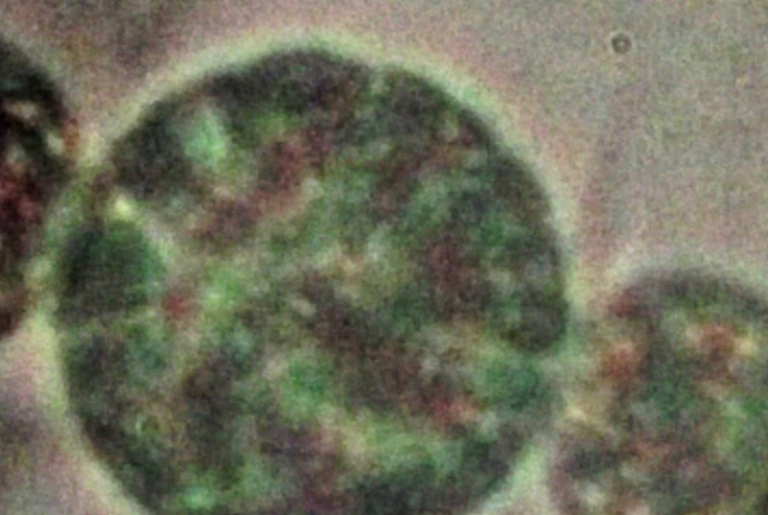
Paulinella chromatophora with chromatophores. Photo Eva Nowack. Source
What is also special is that proteins encoded by genes earlier transferred to the nucleus now make it back into the endosymbiont, where they become incorporated into the photosynthetic system. Such a protein transfer is, of course, a regular event for organelles but it is news for endosymbionts. What is also new – and in contrast to known insect endosymbionts – is that the Paulinella endosymbiont apparently retains all components necessary for autonomous replication of its chromosome. The replication origin oriC is virtually identical to that of its Prochlorococcus cousins and embedded in the same genomic context. Revealing the details of both these processes – gene transfer to the host genome and synchronizing endosymbiont replication with host replication – may shed light into what it takes for an endosymbiont to become an organelle. What is exciting is that this transformation is supposed to have happened only a few times. Here we may be seeing it taking place under our eyes.