
The Uncultured Bacteria
by Kim Lewis

Figure 1. "The Great Plate Count Anomaly."
The majority of bacteria will not grow on nutrient medium in the lab. The basic experiment is simple: take a sample from the environment, such as marine sediment or soil, mix with water, vortex, allow it to settle, dilute supernatant and take two droplets. Plate one on a Petri dish with LB medium, and place the other on a microscope slide (adding a dye such as DAPI helps). Count the number of cells under the microscope and the number of colonies on the Petri dish — the result will be "The Great Plate Count Anomaly." About 100 times more cells will be observed microscopically than colonies counted on the Petri dish (Fig. 1). This simple result is one of the most profound puzzles in microbiology, and one of the most significant unsolved questions in biology. Indeed, microorganisms probably make up the bulk of the total biodiversity of species on the planet, but we do not have access to the vast majority of them. Importantly, most Divisions — the largest taxonomic units — do not have a single cultivable representative, and we know of their existence only from 16S rDNA isolated directly from the environment.

Figure 2. Growing the uncultured in agar, between semi-permeable membranes, in their original environment.
There are two basic approaches to solving a problem, and one of them is to decide that it does not exist. It has been suggested on the pages of Nature and Microbe that the anomaly only exists in our minds and results from the insufficient number of microbiologists with a "green thumb" willing to tinker with growth conditions. However, the anomaly has existed for over 100 years, and tinkering by generations of scientists produced only minor improvements. A serious effort was mounted by several groups to culture representatives from the ubiquitous TM7 division, for example, but produced no results.
What I find most fascinating in the problem of uncultured bacteria, however, is not the existence of exotic strangers such as TM7, but the fact that many — if not most — "unculturable" organisms are close relatives of common garden-variety bacteria such as Bacillus subtilis or Pseudomonas aeruginosa. Judging by the genomes of their relatives, the uncultured organisms should grow on almost anything, yet they grow on nothing in the lab, including yeast extract which contains the entire metabolic map. They do grow in soil or marine sediment, so should be able to consume degradation products of plants and animals, which would be sugars and amino acids. The puzzle is truly perplexing.

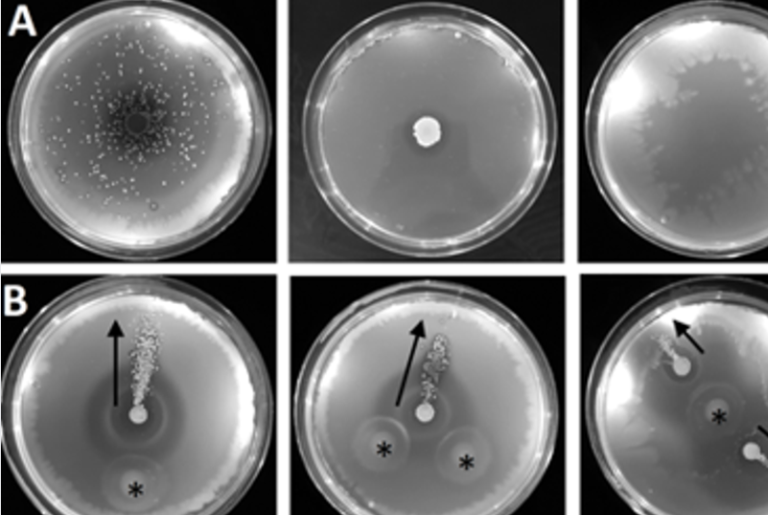
Figure 3. A sample from marine sediment biofilm is inoculated on a Petri dish with rich medium (left panel). Inoculating colonies from this plate pairwise (right panel) allows to identify uncultured organisms and their helpers. Material from one colony, KLE1104 (close relative of cultivable M. polysiphoniae) was spread evenly over the plate, while cells from another colony, KLE1011 (related to M. luteus) were patched in a single spot. KLE1104 colonies only form around KLE1011.
Given the unsuccessful 100 year-old quest for a good medium, we gave up on the hope of recreating it in a Petri dish. Instead, we decided to grow the uncultured in their natural environment, where one cannot possibly fail! Enclosing a marine sediment sample mixed with agar between semi-permeable membranes and placing it back in its original environment then allows for free diffusion of compounds through the chamber (Fig. 2). The bacteria are tricked into perceiving this diffusion chamber as their natural habitat, and form colonies. Similar approaches of culturing in their natural environment resulted in cultivation of dominant pelagic Pelagibacter ubique by Steve Giovannoni's group, and Prochlorococcus by Zinser and co-authors.
One useful clue to the nature of uncultivability came from our observation that some uncultured organisms will only grow in the presence of cultivable species from the same environment (Fig. 3). Using this as an assay, in collaboration with Jon Clardy's group we discovered that growth factors for many uncultured species from biofilms enveloping marine sand grains are siderophores, chelators of insoluble Fe(III) (Fig. 4). Some species are fairly promiscuous in taking up siderophores, while others, such as a distant relative of Verrucomicrobia, will only grow in the presence of a siderophore from a particular neighbor.

Figure 4. A culturable helper releases a siderophore that captures insoluble Fe(III) and brings it into the cell. The same siderophore/ Fe(III) complex is captured by an uncultured bacterium which is unable to make its own siderophores.
But why would bacteria lose the ability to make a factor necessary for capturing an essential nutrient, thus becoming dependent on their neighbors? This dependency, of course, leads to loss of liberty; uncultured species can no longer colonize new territory. Simple advantages of thievery are unlikely to provide a credible explanation. Indeed, siderophore piracy is well-known among bacteria, but the cultivable pirates retain their own siderophore operons and turn expression on when iron gets low. I think that the reason for the loss of siderophores is to prevent adaptive evolution in new environments. Any time a cell finds itself in new surroundings, it will evolve to increase its fitness. This newly evolved organism is unlikely to outcompete resident species that spent millions of years adapting to the same environment, and will die out. Going back to their original environment is not an option either; they are not the same now and will be less fit than their parents (Fig. 5).

Figure 5. Upper panel Death by an evolutionary dead-end. A culturable bacterium propagates in its familiar nich (yellow) and sheds off a cell that travels to a new environment (grey) where it attempts to adapt by evolving new features and losing some old ones. It is unable however to compete with a resident species (purple), and is no longer competitive with the parent strain. Lower panel An uncultured organism depends on a growth factor from a neighboring species. If a cell finds itself in an unfamiliar environment, it stops dividing and waits for a ride back, where it resumes productive propagation.
This scenario has been described for our pathogens such as P. aeruginosa which looses a large number of genes, including virulence factors and proteases, while adapting to the environment of the lung of cystic fibrosis patients. The result of such runaway evolution is a dead end; the pathogen can neither infect new hosts nor return to soil, its other major habitat. This is probably the main fate of weeds like P. aeruginosa or E. coli — death by adaptive evolution. The other 99% of species choose where they live and grow. If they find themselves in an unfamiliar environment, then the best strategy is to go into dormancy and wait for a ride back home. This strategy is very similar to what we know about spores of cultivable species such as B. subtilis. Spores will germinate on any nutrient environment, but the probability of germination is greatly increased in the "correct" environment. Alanine (for reasons we do not understand) is a good germinator, and so are products of peptidoglycan hydrolysis from neighboring species. B. subtilis seems to be an intermediate between a true uncultured species and a weed like E. coli.
What is next? The siderophore story suggests that there are other growth factors to be discovered that indicate a familiar environment to the unadventurous uncultured. (Next year: the uncultured from the Human Microbiome.)
Reference
D'Onofrio A, Crawford JM, Stewart EJ, Witt K, Gavrish E, Epstein S, Clardy J, Lewis K. (2010). Siderophores from neighboring organisms promote the growth of uncultured bacteria. Chemistry & biology, 17 (3), 254−264. PMID 20338517
All figures courtesy of Kim Lewis.

Kim Lewis is Professor of Biology and Director of the Antimicrobial Discovery Center at Northeastern University.




What a wonderful essay—hats off (literally) tp Elio and Merry for inducing (!) Kim Lewis to write it! I actually used one of Dr. Lewis' articles in my micro class last semester. And the "No microbe is an island" (to borrow from John Donne) meme is one of my "Four Heresies of Microbiology" that I find few students consider.
This is a GIANT value to STC. No textbook can cover the kinds of things that the blog brings up, written by the experts. Sure, it might be possible to get those experts to write an essay for a textbook, but that takes years to make it into print. Blogs like STC are much more immediate.
What a great summary of a central idea of the "new" microbiology evolving right before our eyes...
Oh, and I would fold Julian Davies' concept of the "parvome"—a "universe" of small molecular weight compounds secreted by microbes—into this fine scientific mixture! I would call it a souffle, but there is nothing airy and light about the work!
Awesome post, thanks! Here is one of the current paradigm drifts in our understanding presented clearly and concisely so that any intelligent person can get the idea. Perfect — I will be passing this on. (And roll on results from the Human Microbiome project!)
Thanks for the fascinating article.
What percentages of a particular animal's cell types will grow in isolated culture in a lab?
Is it possible that these different uncultivatable bacteria are specialized 'somatic cells' of a diffuse multicellular organism, whose cells differentiate via rearranging genomes by import and export of genes instead of turning them on and off?
and the ones that are more adaptable can be considered the germ line that can colonize new environments.
Or perhaps the bacteria don't even have to escape their specialized 'dead end' environment? all they have to do is have certain key parts of their genomes exported by viruses? If you are thinking of evolutionary dead ends... just what is the boundary for an evolving bacterial genome, after all?
Wish I had time to learn more about this stuff.
I really like the subject and I found this article very interesting. I was struck however by the sentence:
" I think that the reason for the loss of siderophores is to prevent adaptive evolution in new environments."
I actually had to read it a number of times to convince myself that I had actually read it correctly. It is the word 'reason' and the intentionality implied in the further discussion that irks me. It seems to me that organisms that have evolved themselves *out* of the ability to propagate in new environments have hit an evolutionary dead end and that his was not a choice, this was an accident. As interested observers we can mourn the loss. Think of the obligate intracellular symbionts and ultimately mitochondria here and shed a single tear. However, if the target of selection is the bacterial cell itself (or lower) then the idea that an individual might intentionally limit his ability to grow in new environments makes little sense. I think the explanation for failure to retain the genes for siderophores is more likely a case of losing an ability because your environment always has this resource in abundance and possibly it's expensive to maintain (much like the obligates and even the mitochondria). This can possibly be tested in genomic comparison once we have sequenced these difficult to grow organisms. If the organisms are generally going through genome reduction then it is worth considering unculturable organisms as a special case of stable and 'generous' environments leading to gene loss and evolutionary dead-ends in the ways that the Buchnera have been a model for this sort of genome degradation.
Thanks for an interesting reminder of this fascinating subject but I think we need to revisit interpretations that invoke mechanisms for bringing about evolutionary dead ends and consider the case for gene loss in these cases as an accident.
As one would expect from Kim Lewis, a great summary of a provocative topic!
With so many possible ways in which bacterial species could be unculturable one might wonder if there are:
Pairs of species that must be in direct contact for some reason or other to grow? Rather than exchanging nutrients could a species become a 'parasite' of the so-called housekeeping genes? This might require direct contact and exchange of cytoplasm.
There are known consortia of archaeal and bacterial organisms that do appear to be in some kind of contact. The range of possibilities is really pretty large.
Thank you again for this wonderful piece.
Thanks to all for the positive comments, and I would like to reply specifically to Heather Hendrickson's suggestion that loss of an ability to make siderophores is part of shrinking the genome in a stable environment where certain nutrients are always plentiful. This is a very perceptive comment, and seems to be true for at least some uncultured bacteria. Specifically, Pellagibacter ubique that lives in the open oceans has a small genome and a number of auxotrophies. Another likely case of a poorly cultivable organism/small genome is pelagic Prochlorococcus. We have started sequencing some of the uncultured marine sediment isolates, and so far do not observe any genome reduction as compared to their cultivable relatives.
Interesting discussion of one of my favorite topics! I would also suggest that there is an additional wrinkle beyond 1) People don't try hard enough to culture them and 2) They are truly unculturable.
It seems to me that a 3rd option is something like "It would have been impossible to try all the possible media formulations to culture more, and it might have been hard to tell if you succeeded; now, the tools at hand let us do this more effectively". Suppose that you put your soil or water sample onto LB, R2A, and a few other undefined media. In the past — i.e. before cheap, rapid sequence based id, you would have seen the "great plate count anomaly" on all of them, but wouldn't have been able to tell if the colonies on LB were the same as on R2A and the others (I'm pretty sure they aren't), aside from a few striking examples. This gets worse when you realize that the same thing looks very different on different media. Yes, I know I'm preaching to the choir here!
I think Heather's suggestion and Kim's response highlight (obliquely) the difference between then and know. Even when I was a grad student (1995–2001) the idea that we would isolate a bunch of environmental bacteria using a novel culture technique, then HAVE THEIR GENOMES SEQUENCED to figure out how they differed from the cultured variants was an absurdity, but now it is, if not trivial, at least reasonable! Now, in a matter of weeks/months, you can have a huge pile of info to tell you if they have lost the gene for siderophores, or if they are regulated by some set of environmental factors besides iron (cell-cell communication...). Then you can design experiments to figure out how/why they are that way. And all of this is without even getting into all the cool new tools for molecular genetics that can be brought to bear! I think we who are in the middle of this don't even realize how big a deal it is. Alas, there is the temptation to rely on technology to do the heavy lifting, which is why I find posts like this so refreshing, reminding us that it is the combination of new technology with basic sound principles of microbial science that allow for this sort of thing.
Very nice essay and discussion. One factor that I didn't see mentioned but is important, at least in the extreme halophiles, is nutrient levels (an idea introduced to me by Richard Shand). It seems that in some cases the levels of nutrients in laboratory media that makes E. coli so happy creates a fatal stress on other organisms. By using very low nutrient levels it is possible to culture a couple-several orders of magnitude greater cell types out of high salt samples than can be obtained using nutrient levels like one sees in LB or other rich media.
One big disadvantage or barrier with this technique is time — colonies can take one to two months to appear! I wonder how much of the uncultivated majority we are missing because we don't have the time to wait for them to grow. If I remember correctly the bacteria from the single-microbe ecosystem deep in an S. African gold mine had a doubling time of years, it's hard to see how one could perform conventional microbial techniqes with a bug like that.
To pile onto E.J.'s comment, the growth rate of the bacteria in a mixed culture is a big issue too. I just had this experience, where I wanted to cultivate an organism that was present in high numbers in an environmental sample (and a close relative to things that are culturable), but it kept getting beaten out in the growth race on agar (even fairly low nutrient ones). Eventually we put it on water agar, and then picked isolated microcolonies to richer media, and they grew fine. Of course, this takes patience, and you need the culture independent data that tells you that there is something there to find. So I think the big take home message (and certainly one that was strongly present in the original essay) is that clever culture techniques should be a big part of our repertoires, to complement the "big biology" sequencing and environmental analysis approaches.
Paul makes good points as always, but I would say that we all need to think about culturing and how microbes evolve to "fit" that culture condition. Back in the old days, we used to store some bacterial strains in stab vials kept at room temperature: high nutrients, high percentage of agar, low oxygen. The idea was that they grew very slowly. I used to look for phenotypic variants of marine bacteria by storing my type strains in stab vials!
Microbial genetics is nothing if not plastic...and context is everything!
Out of curiosity, if it were possible to culture all unculturable bacteria from a sample, then are there applications that might be of commercial importance? Sick vs healthy soils in agriculture?
Elio replies: I would think so, although,a you say, the proof requires culturing them and then trying them out.
I propose that unculturable bacteria could be grown particularly in human samples by eradicating normal flora in the sample that could interfere with the growth of bacteria. The most problematic contaminant is staphylococcus epidermidis which is commonly cultured in human culture specimens. I propose the use of staphylococcus epidermidis bacteriophages to eradicate staphylococcus epidermidis thereby allowing the unculturable bacteria to grow because the the staphylococcus epidermidis bacteriocins kill off the unculturable organisms.
I propose the use of thioglycolate containing urine collection cups to enhance the growth of bacteria. One important error that I have noticed in many laboratories is that urine is often left too long before being processed thereby reducing the survivability of bacteria particularly in low grade infections.
I propose the use of PQQ , a vitamin like compound in transportation media and in agar plates to enhance the growth of bacteria. One study found that it had growth promoting effects on bacteria. Maybe PQQ could be used along with the sidophores to promote the culturing of unculturable bacteria.
Biofactors. 1988 Jan;1(1):51–3.
Pyrroloquinoline quinone: excretion by methylotrophs and growth stimulation for microorganisms.
Ameyama M1, Matsushita K, Shinagawa E, Hayashi M, Adachi O.