
Talmudic Question #63

by Stan Zahler
When you streak out Your Favorite Bacterium on an appropriate agar plate, the colonies reach an expected diameter and stop growing. Why?
Corollary: If you inoculate YFB in the center of an agar plate and incubate it, it would reach its expected diameter. What do you predict would happen if you touch the tip of a sterile hair to the edge of the colony, draw it out on the agar radially, and re-incubate the plate?
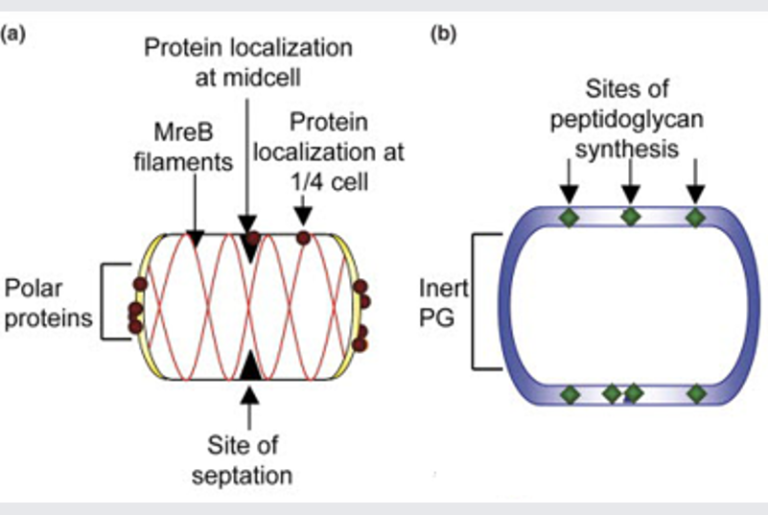


My guess: the agar dries out and becomes less hospitable to YFB as time goes on, thus limiting the rate of growth. Another possibility is that YFB creates waste products which don't diffuse far from the colony and thus prevent the colony from growing very large.
Response question:
If YFB is P. mirabilis or B. mycoides, they don't stop growing. Why not?
And in many cases, the colonies are smaller on "crowded" plates. Nutrient limitation? Something else? I am writing a post about this for Elio and Merry to be submitted this weekend. Colonies are more like organisms than we think, and are they really "clonal"? Not so much!
Is that really the case? It's not consistent with what I remember. I don't do much bacterial work now, but I did lots in grad school. We would often have plates sitting on our benches for several weeks. As I recall, colonies would often continue to get larger, albeit at a slower rate. (Dehydration of the agar was definitely a factor, thought.)
The little bit I could find in PubMed also doesn't suggest a halt in colony growth. E.g. see Peters et al., J Gen Microbiol 133:1257–1263 (http://mic.sgmjournals.org/cgi/reprint/133/5/1257?view=long&pmid=3116170). They seem to show colonies of B. cereus, E. coli, & S. albus continuing to grow over at least 7 days.
Could it be a perception problem? When the colony is sufficiently small, a large fraction of the cells may still be actively dividing, giving a fairly rapid increase in colony size. As it gets larger though, cells in the middle probably aren't dividing much. Only a small fraction of cells on the rim, where nutrients aren't depeleted, may be still dividing. So, the radial growth rate slows down. If you don't purposely grow the colonies for long times, taking periodic measurements (and keeping humidity up so the agar doesn't dry out), maybe that slow down is misperceived as an actual stoppage?
Hmm. Maybe next time I do a transformation, I'll try little test.
As we inoculate bacteria on agar plate it forms a colony and reach an expected diameter because the bacterial colony gradually start moving from central to radial direction.As the colony grows it first utilizes the glucose which are present centrally gradually it moves towards the radial part where it has more access to glucose.In case of yeast it has been shown to form o gradient of glucose and pH.The pH of the central also turn more acidic compare to radial.So both the nutrient and pH may be one of the role for this kind of colony structure.However why it stops after growing a definite diameter? I think, mobility of microbes depend on the interaction between certain protein and surface roughness of the surface.In normal agar plate its roughness doesn't allow to have sliding mobility whereas in low percent agar, in many cases it forms colony of larger diameter compare to normal.However it also depends on many factors, in some microbes it has been shown to secrete certain protein which helps to have a sliding motility.
This is all a great thing to discuss. I have colleagues who used microprobes to demonstrate that the interior of colonies was essentially anoxic.
Fact is, colonies are strange things:
http://www3.interscience.wiley.com/journal/109913378/abstract?CRETRY=1&SRETRY=0
And:
http://www.ncbi.nlm.nih.gov/pubmed/9891813
And some interesting photos:
http://www.microbelibrary.org/asmonly/details.asp?id=1611&Lang=
I also think that not all microbes are created equal with regard to this phenotype. After all, agar plates and pure cultures and single colonies aren't all that common in nature?
Well, anything with swarming motility will fill the plate (often quite beautifully). I think one issue is more that most of our "YFBs" have been selected for good behavior on plates. It's _hard_ to get nice isolated colonies of wild Bacillus or Vibrio strains.
Paul said: "Another possibility is that YFB creates waste products which don't diffuse far from the colony and thus prevent the colony from growing very large." I'll buy that over nutrient depletion or agar drying out, at least as long as YFB isn't a swarmer.
As for the corallary, I'd think that if you streaked away radially from the edge, you should get growth again. These cells would have been the most actively growing before the growth inhibition due to the buildup of waste products, so they should resume growth right away. Besides, they taught us to inoculate from the edge of the colony, so that must be the right answer. 🙂
Stan comments on these comments:
By definition, a Talmudic Question shouldn't have a simple answer. This one surely depends greatly on what Your Favorite Bacterium is, and what medium you grow it on, and how you incubate it.
If YFB is a swarmer, you may be able to inhibit swarming (say, by making the agar 5% NaCl) and then ask the Question.
Some combinations of bacterium and medium can indeed give bacterial growth that is inhibited only by the drying-out of the agar. You can control for this by putting a stack of filter paper in the lid of the Petri dish and keeping it soaked for days or weeks, until the colony covers the whole plate.
Some combos really give a finite colony size. This seems generally to result from toxic products (poorly diffusible?) released from the bacteria. Perhaps a better medium — say, one without sugar, if YFB is a fermenter — will give bigger colonies. Do near-by colonies of YFB fuse as they grow, or inhibit each other?
Do not try to answer this Talmudic Question if YSB produces an agarase.
— Stan Zahler