
Talmudic Question #62

What if all prokaryotic plasmids on this planet went on strike and refused to have their genes expressed?
What if all prokaryotic plasmids on this planet went on strike and refused to have their genes expressed?

Pictures Considered #17 by Elio — Described as the "Most Beautiful Experiment In Biology" the demonstration by Meselson and Stahl that DNA replicates semiconservatively is one of the major landmarks in the genesis of modern biology. And indeed it is most pleasing, both visually and cerebrally...

by Elio — We seldom post items of immediacy, but here we interrupt our leisurely ways to write about the current disastrous meningitis outbreak caused by the injection of fungus-contaminated steroids and other drugs. As microbiologists, the question comes to mind at once: Who is the pathogen? The fungus implicated is Exserohilum rostratum(although a couple…

by Veronica W. Rowlett — Predator-prey relationships exist all over the world of living things, from microbes to animals and humans. In defense against predators, animal prey use varied strategies such as hiding from, distracting, escaping, or fighting predators. Humans build walls and ramparts to protect themselves within cities from potential animal or human aggressors. But how do bacteria defend themselves...

Unlike many bacteria, which undergo undergo fancy morphological development (spores, hyphae, prosthecae, etc.), archaea do not. Why do you suppose this is?

by Elio — As the school year begins, we would like to hear from you about uses that you may have for this blog in your classroom. We think that the material here lends itself particularly well to use as supplemental readings ─ providing intellectual enrichment to students who desire it. The blog has been mentioned in class...
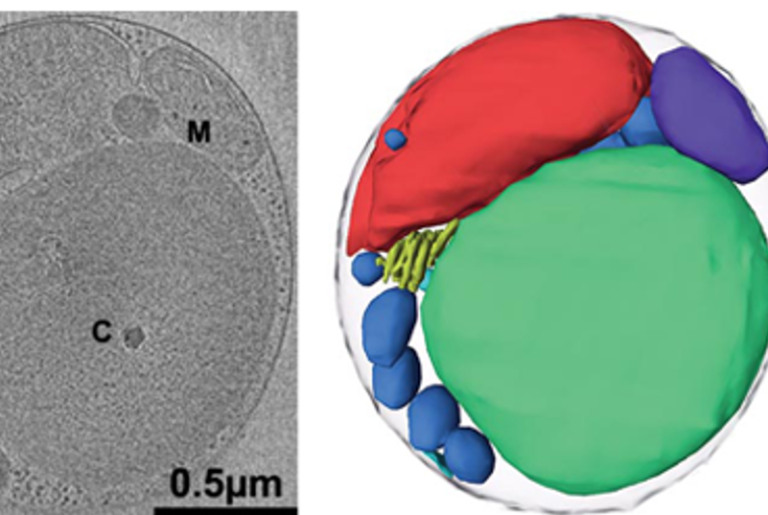
Pictures Considered #24 by Elio — Ostreococcus tauri is about as small as a free-living eukaryote can get. Its disk-shaped cells are as small as 0.8 µm, which makes it possible to examine them by electron cryotomography. As reported in a paper from the Jensen lab, there is barely enough room in these cells...
Well, at the very least, it'd be bad news for those cells containing plasmids with toxin-antitoxin modules. No transcription = loss of toxin protection due to antitoxin degradation.
Let me respond Talmudically, or at least in the style of Augustine: first, tell me the difference between a plasmid and a chromosome, prokaryotically speaking? The Real World of Microbes—as opposed to the world of Petri dishes and 2059 tubes— has plasmids with over a million bases, organisms that appear to have a series of plasmids instead of a chromosome, and so on. The prokaryotic world seems to be about thumbing its collective quorum sensing microbial nose at conventional wisdom and accepted paradigms. We need a new dictionary, I think, while Chomsky laughs out loud.
In addition to bad news for bacteria with plasmid-encoded toxin-antitoxin modules (see above post by HappyPig), I suppose that mankind would both benefit (reduction in antibiotic resistance and loss of virulence factors) and suffer (loss of bacterial enzymes that de-toxify chemicals in the environment).
Well, I don't know if this is a good thing or not, but many GM crops are modified by plasmid insertion. Crop failures perhaps, and/or a severe dent in share prices of agro-chemical multinationals?
On the bright side, my job as an infectious diseases doctor would be made a lot easier if plasmid mediated antimicrobial resistance genes were to stop expressing.
By the way, where do transposons fit in this question?
There are many examples of biosynthetic genes carried by plasmids, as well. For example, Sinorhizobium meliloti has vitamin biosynthetic genes carried by one of its two "megaplasmids." So "Talmudic" doesn't begin to describe the twisty complexity of this topic.
Microbiology and biochemistry labs would be in big trouble... none of our constructs would be useable!
Since most free-living bacteria harbor one or more plasmids and most plasmids harbor one or more addiction modules (toxin antitoxin loci), many of which determine potent toxins, most such bacteria would be severely compromised or die were their carried plasmids to call it quits. The term addiction module denotes a genetic locus that addicts its carrier to its continued presence. A typical addiction module determines a stable toxin and a relatively unstable antidote that normally suffices to completely neutralize the toxin. Thus, the phenotypes of potentially lethal addiction modules are paradoxically expressed only in the absence of their genes. Prokaryotes have many uses for programmed cell death (1).
As more and more varieties of addiction modules came to be recognized, many as part of bacterial chromosomes (often within mobile elements), it became clear that they constitute a major class of stress response elements. Moreover, bacteria that are obligately host-associated and therefore enjoy a stable environment, lack these potentially damaging loci (2). Therefore, were bacterial plasmids to call its quits, we might still be left with those bacteria that reside intracellularly. Not for long, however, as life without free-living prokaryotes is not worth living.
1. Yarmolinsky, M.B., Science 267: 836–837 (1995) Programmed Cell Death in Bacterial Populations.
2. Pandey, D.P. & Gerdes,K., N A R 33: 966–976 (2005) Toxin-antitoxin loci are highly abundant in free-living prokaryotes but lost from host-associated prokaryotes.
Michael Yarmolinsky
Don't worry if it happens it will start in France... it's our national sport!