
Talmudic Question #46

by Daniel Portnoy
Why don't mammals make antibiotics of the type so readily made by bacteria and fungi?
by Daniel Portnoy
Why don't mammals make antibiotics of the type so readily made by bacteria and fungi?
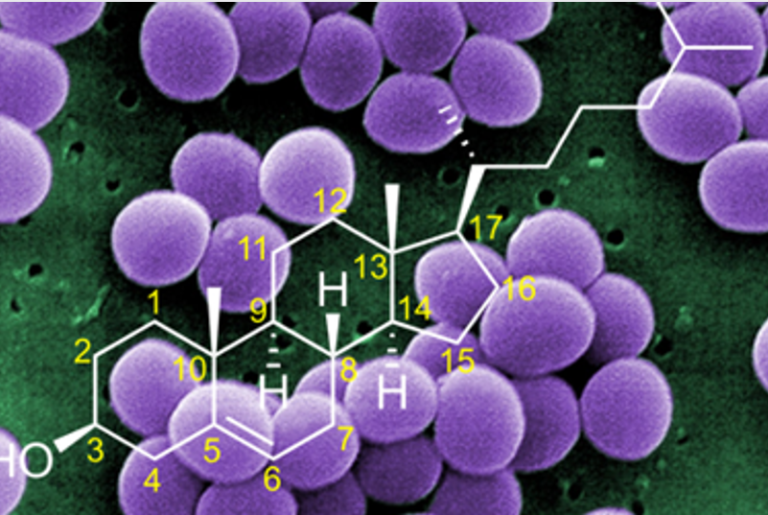
by Elio — Cholesterol and MRSAs vie for headlines. Both are formidable topics of enormous interest to readers of mass media and to scientists (many of whom read mass media, probably in the bathroom). It turns out that Staphylococcus aureus and arteriosclerosis have...

by Jamie Henzy — By now, many of us are aware that a considerable portion (45% or more) of the human genome consists of transposable elements. These are mobile genetic sequences, such as Alu repeats and long and short interspersed nuclear elements (LINEs and SINEs). A whopping 18% of this so-called "dark matter…

by Elio — Cytokines are small proteins (~5−20 kDa) that play a large role in our defenses against infection. They stimulate both the innate and the acquired immunity and coordinate the interplay between the two, thus can be properly called immunomodulators. There are lots of them, including interferons, interleukins, tumor necrosis factors, chemokines...

by S. Marvin Friedman — The emergence of multiple drug-resistant bacterial strains, the prevalence of recalcitrant biofilm configurations, and the reluctance of the pharmaceutical industry to initiate new antibiotic discovery programs have led to the development of a formidable population of bacterial pathogens that is increasingly difficult to control. After a long but successful era of research…

by Franklin M. Harold — Concerning the origin of eukaryotic cells, much has been written but almost everything remains to be settled. No one disputes that mitochondria derive from free-living bacteria that established an intimate symbiotic relationship with a host of some kind and progressively turned into organelles, workhorses of metabolism, and a hallmark of eukaryotic…

by Elio — The August 2016 issue of Environmental Microbiology is a treasure trove of articles on symbiotic relationships. I happen to have a soft spot for the subject (am I symbiotic with symbioses?), so this issue is a handsome gift. I will comment on just a few of the articles, chosen with some effort from all this wealth.
Dr. Portnoy, I have long admired your work. Great question for discussion.
I'm with Julian Davies, that bacterial antibiotics may be as much signaling molecules as antimicrobial agents. I have never seen any evidence of soil bacteria-synthesized antibiotics inhibiting the growth of other bacteria in microcosms. I could be wrong, of course. Dr. Davies suggests that we are looking at vast overdoses of these agents that have medical relevance.
I don't know about the whole Xenorhabdus/Photorhabdus situation inside insect carcasses, however. Those bacteria make antimicrobials, and perhaps they do exclude other bacteria after all. It seems like an exclusive niche.
I haven't heard about eukaryotic defensins that target translation, transcription, or replication directly. They can go after membrane integrity. But it is a field far from my own expertise.
Eukaryotes certainly make a wide variety of antimicrobial proteins that appear to recognize aspects of invading prokaryotes. The innate and adaptive immune systems are beautiful things! Hmmm. Do protists make antimicrobial agents?
You do write pithy comments, Mark! Now I have to go look up the word "defensin"; I intuit what it probably means, but I've never encountered the word before.
Ever since I saw Mark's reply, I've been thinking about this (I should have been working). I am going to slightly dissent from the signaling hypothesis ‑that isn't to say that there is no signaling role, but that the default assumption should be that the antibiotics do what we observe them to do, not something else. They are produced at high enough levels to have local strong inhibitory effects — however, the medical relevance point remains. I think there have been some ecological studies showing that in some rudimentary models, the production of antibiotics prevented invasion of the producers territory by competitors — it was late, so I didn't take down the cite, unfortunately.
Rather than argue against Mark (a bad idea!) I think an interesting possibility is that fungi and bacteria adopted colonizing lifestyles (starting from a cell/spore, expanding outward) whereas protozoa and later metazoans adopted highly motile lifestyles and relative autonomy (this leaves out plants ‑sorry for the pun). So one strategy is to protect your territory, the other is to leave when the going gets tough? Defensins would then be explained as a later adaptation on top of multicellularity.
By the way, while protozoa may or may not make secreted antimicrobials, they certainly have lysosomes...which is where legionella and mycobacteria learned their tricks, right?
Because humans don't compete for the same ecological niche as bacteria.
We benefit from the vast majority of bacteria in our normal flora. It is only in immunocompromised situations or infections that bacteria are not helpful in our life cycle.
Paul, you are very civil, as always. Back atcha, as the saying goes.
I am interested in those citations showing that, say, antibiotic producing Streptomyces do "better" (in terms of niche utilization) than non-antibiotic producing Streptomyces in mesocosms. So if you find them, send 'em my way.
I could certainly be wrong (I don't mean to go all Socratic on you; I am painfully aware of my limitations, however). We microbiologists tend to suffer from both colicentricity and even eukaryocentricity—we don't often "look" at things from a "microbial perspective," where (as you suggest) the concentration of a given signal molecule might be quite high locally. And the Xenorhabdus/Photorhabdus example might be quite apt.
Plants indeed use many "stationary tricks" to exclude competitors (allelopathy comes to mind), and there is even evidence that plants undergoing insect attack produce volatile signal molecules that "warn" nearby plants to prepare for arthropod mandibles!
But Paul's ideas give me plenty to think about...
As for Brandt Levitt's comment, we *are* a complex collection of niches for which human associated microbes compete. What is the saying (someone from UC Riverside, I think)?: humans are nothing but a bunch of ecosystems, walking around.
Another comparatively prosaic reason might be the commensal nature of our own microbiota — how many generations would it take to go from the first crude antibiotic excretion to something that somehow only targets "harmful" microbes?
Yet another, related to this, is the fact that fast-reproducing bacteria and fungi can evolve defenses to antibiotics much, much faster than any mammal population could keep up with, so even assuming by some amazing coincidence that some mammal began producing an antibiotic that targeted only a common harmful microbe, resistant strains of that same microbe would be likely to show up in the population before the next generation could even get started...
does bile acid in the gut, lysozyme in tears and antimicrobial properties of the Rhino sweat (I just read that) constitute as mammalian antibiotics? these secretions target certain bacteria and reach a balance between killing harmful bacteria and selecting for useful ones.
no?
I have my own answers about issues involving the lack of selective pressure due to being a highly multicellular organism...
,,,BUT...
...the insightful responses that are ALWAYS offered for these 'Talmundic Questions' are...for lack of better words....inspiring. Thanks commenters for ALWAYS pushing my brain....
Maybe because (with some exceptions) their role in nature is not to kill other microbes but to communicate and interact with other microbes (Mlot, C. 2009, Science, 324: 1637–1639). Intercellular communication mechanisms between cells of multicellular organisms might be different because the cells are not separated in space? That is, the types of signalling molecules (proteins, nucleic acids, etc.) used by cells of multicellular organisms can be more "fragile" because they do not have to enter the "environment" before reaching their "target" cells? Maybe.