
A Fly in the Frozen Custard
by Elio
Don't you just love a good controversy? Take, for instance, the discussions on long term survival of bacteria. Depending on your point of view, bacteria exist in salt formations going back 250 million years, in 50 million year old amber, or in 500,00 year old permanently frozen ice or permafrost. Some researchers report the isolation of viable bacteria, others are content with their DNA (usually in pieces). Finding something interesting turns out to be relatively easy; proving that it originated when you say it did, less so. The farther back you go, the more contentious the issue becomes. But increased experimental sophistication is being brought to bear and the conclusions about long-term survival are becoming more pointed.

Glacial ice in Antarctica. Source
A cherished notion has been that the surviving cells are in some form of dormancy. Surely what comes to mind are spores, those masters of resistance, no?
This thought has come under scrutiny. For starters, bacteria surviving in ancient ice formations are not all sporeformers. Furthermore, perhaps dormancy is not sufficient. Maybe survival depends on a small measure of active metabolism, enough to support DNA repair. Think about it. A spore may be resistant to a wealth of physical challenges, but its DNA is still vulnerable to natural radiation. Indeed, sporeformers lack active DNA-repair machinery, but this is a generic problem, true for any cell that endures for a long time. So, the notion that DNA repair takes place pari passu with damage is appealing.
A group of scientists from no less that 6 different countries (Australia, Canada, Denmark, Russia, Sweden, USA) came up with the alternative to dormancy. They analyzed samples of continuously frozen permafrost, some going back 500,000 years, and concluded that the bugs therein are actually active, albeit at a very slow rate of metabolism. Isn't this a neat way of thinking about the problem of long term survival?
To determine whether those bugs had been repairing their DNA all those years, the authors used a clever experimental strategy based on a reaction that proceeds at a relatively slow rate: the spontaneous deamination of cytosine in DNA to uracil. Active cells can repair this damage, replacing the uracil with cytosine. How can you tell whether the uracils have accumulated or been repaired? Treat the DNA with uracil-N-glycosylase, an enzyme that breaks the ribose-uracil bond. This fragments DNA that contains unrepaired uracils but leaves intact the repaired DNA. Long (4 kb) amplicons can only obtained from DNA of metabolically active cells because uracil-containing unrepaired DNA will be cut into smaller fragments.

Colwellia psychrerythraea, a model cold-adapted organism. Source
The authors started with samples of DNA recovered from permafrost and Antarctic ice of varying age, ranging from modern up to 1 million years old. Following treatment with uracil-N-glycosylase, they PCR-amplified 4 kb fragments that included portions of 16S and 23S ribosomal RNA genes as well as the ITS region. With the base sequences in hand, they could identify the organisms present in samples of varying ages. In the oldest samples, the dominant bacteria were members of the high-GC Gram-positive Actinobacteria largely related to the nonsporeforming Arthrobacter. The amount of intact DNA recovered from sporeformers, on the other hand, declined with time.
The authors also showed that samples up to about 600,000 years of age evolved CO2 while frozen at −10 °C under anaerobic conditions for some 9 months. This suggests that even when frozen, some slow metabolism continues. Ergo, DNA repair may be possible.

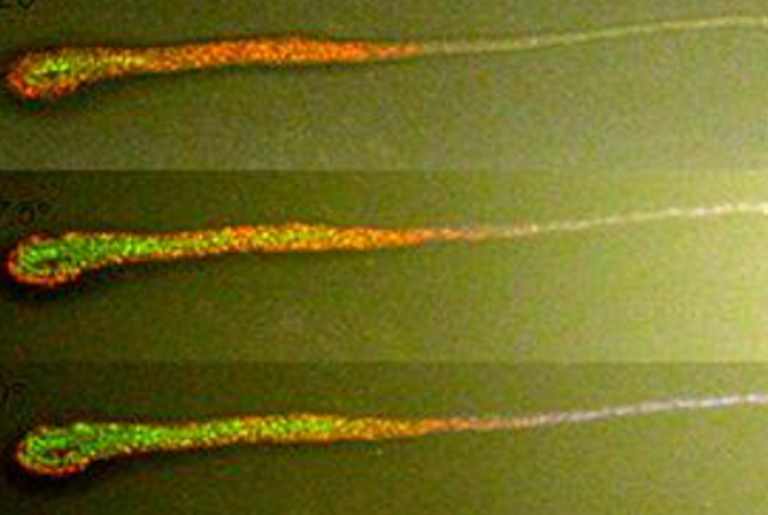
Wow! Look at this! This phage thinks Colwellia psychrerythraea is metabolically active. Source
There is, however, a fly in the frozen custard. A thoughtful paper by several authors at Northeastern University in Boston brings up the observation that old ice is not all that uniform, but is riddled with channels filled with liquid water. Active metabolism is likely here. Some psychrophilic bacteria such as Colwellia psychrerythraea, are capable of swimming at high speeds at −10°C; others are capable of dividing every 160 days in permafrost samples maintained at −20 °C in the lab. Furthermore, some bacteria appear to have physiological mechanisms that enable them to adapt to very cold conditions. Is it not possible then, that the bacteria found in permafrost or glacial ice may not be all that ancient? That they are alive and well and going about their business at a respectable pace in your frozen custard?




This is a great addition to my "Father Time and the Microbes" discussion in my own microbiology course.
I particularly appreciate the point about DNA *within* spores being subject to innate chemical processes (though, again, microbes may be much smarter than researchers about strategies—isn't there some new work with Deinococcus and metals acting as chemical protectants to DNA?). Nice work and it will be fun for the students.
Anyway, I like to start with—as you are alluding to in the earliest part of your post:
Cano, RJ and MK Borucki. (1995). "Revival and identification of bacterial spores in 25 to 40 million year old Dominican amber." Science 268: 1060 — 1064.
Yes, it is a controversial paper. Then I follow up with:
Greenblatt CL, Baum J, Klein BY, Nachson S, Koltunov V, and RJ Cano. (2004). "Micrococcus luteus–survival in amber." Microb. Ecol. 48: 120 — 127.
Non-spore formers, too?
And this paper is one I use as well:
Vreeland RH, Rosenzweig WD, and DW Powers. (2000). "Isolation of a 250 million year old halotolerant bacterium from a primary salt crystal." Nature 407: 897 — 900.
There is some discussion in the last few papers regarding "crack propagation."
I also bring in some evolutionary arguments (the students appreciate the assumptions made, and always enjoy seeing scientists battle):
Graur D and T Pupko (2001). "The Permian bacterium that isn't." Mol. Biol. Evol. 18: 1143 — 1146.
Socratically, it is a great topic: how does one tell if a microbe is "ancient" or not? How does one go about isolating microbes from supposedly "metabolically inert" environments...and are they truly inert?
Your post gives a wonderful "third leg" to this subject.
Again, great work Elio!
Oh, and Elio?
Doesn't this topic make you think long and hard about Mars, Europa, and Enceladus?
For me, it surely does.
Thanks, Mark, for the helpful quotes and kind comments. You are right, this is a great topic for discussion. Indeed we could call it a Talmudic one, being that it is not easy to reach definitive conclusions. As for Exobiology, I am busy enough with "Endobiology," if you wish, the contrasting term for "our" Biology.
As always, your comments are important to us and greatly appreciated.
Elio