
Wolbachia Infection: A Good Thing?
by Merry

Drosophila melanogaster. Source
Wolbachia have caused one of the great pandemics in the history of life. They infect at least 20% of the species of arthropods – which adds up to about 106 species – as well as other invertebrate hosts. And they have done this using only maternal (vertical) transmission to infect their next host. Maternal transmission is an imperfect mechanism because all of the progeny eggs don't become infected. If this were the only factor, the percentage of Wolbachia-infected hosts would decrease with each generation. In the course of time, the symbiont would be eliminated from the population. Since the Wolbachia are still here, some other factors must be at work.
You may be acquainted with one of these factors – the strategies some Wolbachia use to manipulate the reproduction of their hosts and thereby increase the number of infected individuals. Such tactics work quite well. For example, they enable the Wolbachia strain infecting one species of fruit fly, Drosophila simulans, to maintain a stable 94% rate of infection in natural populations, even though an estimated 2.5% of the eggs are not infected. (That 2.5% may sound small, but it causes the percentage of Wolbachia-infected hosts to decline generation after generation.)

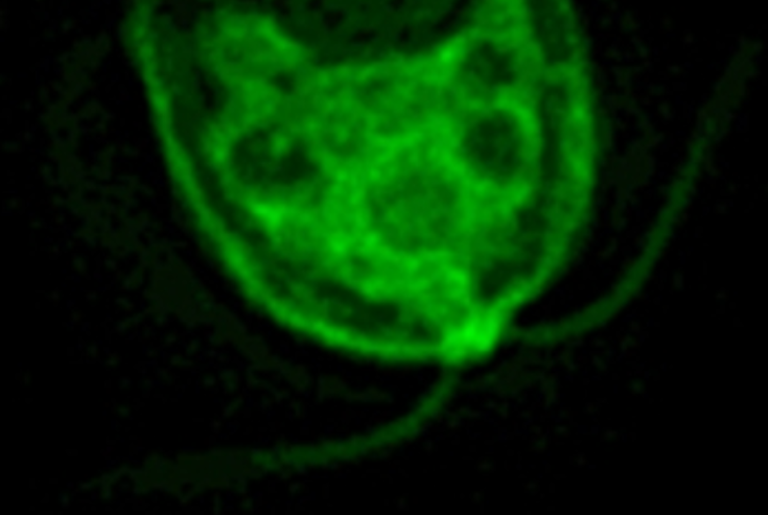
Wolbachia sp. in ovarium cells of a cherry fruit fly. Source: MicrobeWiki, Photo by S. Bluemel
On the other hand, in natural populations of the closely-related D. melanogaster, the infecting Wolbachia doesn't interfere with host reproduction. Still, under some conditions this species can maintain a stable infection rate, at least in certain populations. Such observations suggest that this Wolbachia must be conferring some fitness on its host. Might it be that Wolbachia infection prevents deleterious infections by other organisms?
Researchers have now looked for such effects. Since epizootics caused by pathogenic fungi are a major factor limiting insect populations in nature, a group of Russian researchers asked whether Wolbachia helped D. melanogaster stave off infections by a fungus. They studied infection by an ascomycete, Beauveria bassiana, one of the insect-parasitizing Cordyceps group. When the researchers inoculated flies with spores from this fungus, Wolbachia-infected flies fared better than flies of the same strain that had been treated with tetracycline to cure them of their endosymbiont. Thus, the Wolbachia protects the insects from serious infection by this fungus.

Representation of the icosahedral capsid of the cricket paralysis virus, a close relative of DCV. Source
Insects are also often plagued with viruses, and D. melanogaster is no exception. Both field and lab populations typically show 30–40% infection by DCV, the Drosophila C virus. (The "C" is for Charolles, the town in France where a strain of this virus was first isolated.) DCV is a small, single-stranded RNA virus whose genome contains a whopping total of 2 open reading frames (ORFs) whose products are processed into several proteins. It is transmitted when potential hosts feed on contaminated food. Its pathogenicity appears to be limited to increased larval mortality. Early infection causes 30% of the larvae to die before pupation, versus 20% mortality for uninfected larvae.
However, the virus is extremely pathogenic when injected into adult flies, causing death within 3 or 4 days. Recently, two research labs (click here and here) independently reported that if the adult flies are infected with Wolbachia before being challenged with the virus, they survive longer. The Wolbachia provided similar protection against four other RNA viruses but not against a DNA virus. So, this suggests that this Wolbachia benefits its host by protecting it against RNA virus infections.
But wait. There is another side to the DCV story. Drosophila infected early in development with DCV develop more rapidly than their DCV-free kin. Infected females produce more eggs and more offspring than uninfected kin. They also live longer. As of 1990 when this work was reported, many small RNA viruses were known to infect invertebrates, but DCV was the only one found to increase fecundity. Despite the slightly increased mortality of infected larvae, infected flies have an overall higher growth rate, thus a potential advantage over uninfected populations.
So, are the Wolbachia doing their Drosophila hosts a favor by defending them against DCV infection? A pretty paradox.


Welcome back, Merry and Elio!
Something that I heard discussed at the ASM Beneficial Microbes meeting in San Diego in October: if a high percentage of a population is "infected" with a microbe, can one really call it a pathogen? Isn't it more likely a mutualist that sometimes causes problems?
Buchnera clearly had a positive and straightforward advantage to the aphid partner. I was pretty sure that Wolbachia would have some kind of advantage to the host, as well. You present some fascinating proof of this idea, with more work to come.
Thanks for this great essay!