
The User's Guide to Poly-γ-Glutamates
by Elio
We all carry a box in our head where we deposit intriguing facts that don't seem to connect to anything else. Sooner or later, such cached bits of information emerge and find their place in the scheme of things, just like wandering souls in Purgatory that finally ascend to Heaven. Some do it with a bang.

Poly-γ-glutamate. The number of monomers may be 1000 or more. Source
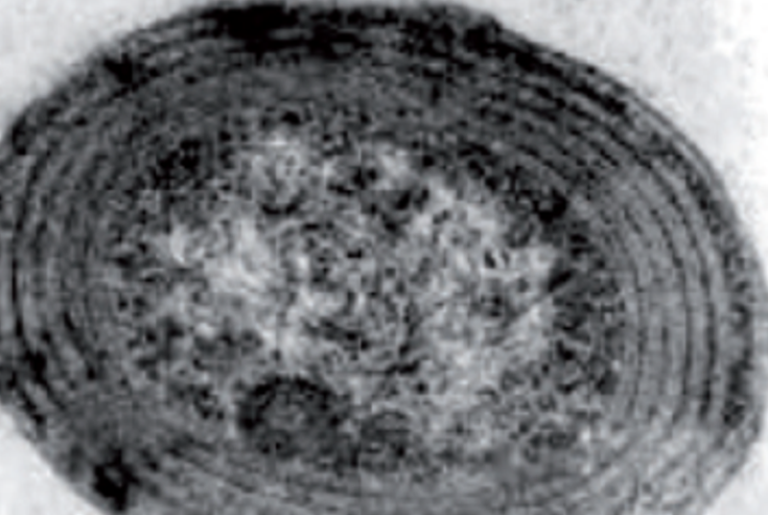
I have in mind the poly-γ-glutamate capsules of some Gram-positive bacteria. I believe I must have first heard of them as a student, long ago. These particular capsules used to be considered an oddity because respectable, God-fearing ones are made up of polysaccharides, not amino acid polymers. But, it turns out mea culpa – that these compounds are far more than a curiosity. For a review, click here.
These odd polymers do plenty.

Natto, a Japanese dish of beans fermented by Bacillus subtilis. Source
High on their list of talents, capsules made of poly-γ-glutamate are virulence factors. In Bacillus anthracis, among others, they help protect the bacteria from being phagocytosed, thus are required for pathogenicity. Some soil bacteria don't use these polymers to make capsules, but instead release them to their environment, probably to sequester toxic metals. Some halophilic archaea use them to lower the local salt concentration. And, for the culinarily savvy, poly-γ-glutamate is the main ingredient of the goo in natto, the pungent fermented beans dish prized by many (but not all) Japanese.
Poly-γ-glutamates are also found in eukaryotic organisms, where they also matter. It has been known for some time that nematocysts, the stinging apparatuses of jellyfish and other Cnidarians, are full of poly-γ-glutamates. These nematocysts, armed with barbs and toxins, are explosively ejected to capture prey and for defense. Large amounts of poly-γ-glutamates, as high as 2 mmol/g tissue, help raise the osmotic pressure to as much as 150 bar, thus giving the oomph to the explosive discharge.

A stinging jellyfish. Source
What ties bacteria and jellyfish together is that a bacterial gene for making poly-γ-glutamate has found its way into the jellyfish! This might well be another example of the rare horizontal gene transfer between prokaryotes and multicellular eukaryotes. Such transfers are frequent in prokaryotes and play important roles in unicellular eukaryotes, but only a few instances are known in metazoans. Another instance seems to have occurred in root knot nematodes (Meloidogyne spp.), although the role of poly-γ-glutamates in these organisms is not yet known.
You'll agree, it sometimes pays to rummage inside that box of quasi-trivia in your brain. Might not be so trivial, after all.


Shenanigans!
Although this is actually a very interesting post, this post's title plainly states that this is a "user's guide", but you still haven't told me how to USE poly-gamma-glutamate!
If you refuse to put up a post describing current or potential culinary, industrial, and/or medical uses of poly-gamma-glutamate I'm afraid I shall be forced to report you to the US Federal Department of Blogs!
Epicanis (Top Dog),
Guilty as charged. We stand ready to serve time. But we did mention natto. Want to try it?
Elio
Elio, I am fan of microbial food, sure. Yoghurt? A big fan. Kefir? Yup. Soy sauce? Check.
Have you tried tempeh? Aspergillus, I think.
Natto? I have to admit I haven't tried it.
But Elio, you need to report on your experiences with huitlacoche! Even I have my microbial limits....
Mark asks me to comment on huitlacoche. He does this because he knows I have a mycological and (he rightly assumes) a mycogastronomic bend. This business has nothing to do with polyglutamates. It does, however, have to do with fungi. Huitlacoche (also cuitlacoche) is just corn affected by the corn smut, Ustilago maydis. When the crops are thus affected in, say Iowa, this is considered a disaster. The corn kernels are greatly distorted and eventually turn black, hardly what one wants to see on the market shelves. In Mexico, catastrophe is turned to good use because the affected corn is quite tasty. See http://en.wikipedia.org/wiki/Corn_smut
"Mexican truffles" is a hype, but huitlacoche has an interesting taste. It's difficult to describe flavors, but it's a bit earthy, possibly like a mixture of corn and mushroom flavors. You won't find it served in mexican restaurants, other than fancy ones, but it's available in cans in specialty stores. Well worth trying! One person's parasite is another one's bonanza!
Actually, I HAVE tried natto. It's not nearly as bad as something that could be described as "rotting, infected, snot-covered soybeans" would suggest. I can't say I actually LIKED it, but it wasn't outright offensive, either. (I think it's quite possible that it'd be good as a minor component of a more complicated dish, but other than one episode of "Iron Chef" I don't think I've ever heard of people using it as an ingredient rather than a stand-alone food).
I guess "eat it with soybeans" technically does count as a use. Besides, I tried contacting the Federal Department of Blogs to report you, but their reply to me was "STFU n00b!", so I'm guessing they won't be pursuing sanctions. You're safe...for now.
I did actually spot one review paper[1] which discusses some uses in the references for the paper you linked to ...and I can obtain limited permission to look at this 7‑year-old article for a mere $31.50 (insert enraged scream here). I was able to glean a few more hints from a more recent patent application I found, though[2]. Sounds like potentially useful stuff indeed, maybe we'll be able to add PGA alongside PLA (Poly-Lactic Acid) as a source of "environmentally friendly" plastics.
[1]Pubmed entry for which is here: http://www.ncbi.nlm.nih.gov/pubmed/16689787
[2]"(WO/2004/007593) POLY-GAMMA-GLUTAMATE HAVING ULTRA HIGH MOLECULAR WEIGHT AND METHOD FOR USING THE SAME" http://www.wipo.int/pctdb/en/wo.jsp?IA=KR2003001369&wo=2004007593&DISPLAY=DESC