
Pico Who?
by Elio
You may have heard that the smallest free-living eukaryote is Ostreococcus tauri. So they say. O. tauri is indeed a tiny green alga. It is endowed with just one chloroplast, one mitochondrion, a Golgi body, and not much cytoplasm. Sometimes it is only 1.0 μm in diameter – yes, smaller even than quite a few prokaryotes. But it is not alone in this respect. In the oceans and elsewhere, one can find lots of other very small eukaryotes.

An unnamed French investigator examines a culture of O. tauri. Source: Le Journal du CNRS
Collectively they are known as the picoeukaryotes; when combined with bacteria, they make up the marine picoplankton (that is, cells 0.2–2 μm in diameter). Although most picoeukaryotes look pretty much alike, they encompass a very diverse group within that catch-all category, the protists. By and large, they have been known for only five or six years, so this is news to many of us. Big news in fact, because they are present in numbers ranging between 103 and 104 cells/ml of seawater. A rough calculation says that their cumulative weight in the ocean (using around 1024 ml as a guess for the volume of the likely habitats) amounts to about 109 metric tons (that's the weight of some ten million blue whales). Say we're wrong by a couple of orders of magnitude, there are still lots of them. This is also the estimated weight of all marine phages, which are some 1000 times more abundant but also about 1000 times smaller than the "picos."

Electron cryotomographic reconstruction of an O. tauri cell. n=nucleus; c=chloroplast; p=peroxisome; er=endoplasmic reticulum; purple=mitochondrion. Source
What do these miniaturized eukaryotes do? The marine picoeukaryotes seem to be about equally divided between phototrophs and heterotrophs. The former contribute much of the total oceanic photosynthesis, apparently outdoing the most abundant phototrophic cyanobacteria, Synechococcus and Prochlorococcus. In a study of central North Atlantic surface waters, only 10% of the surface picoplankton consisted of eukaryotes. But being larger than bacteria, they accounted for 60% of the biomass and 68% of the photosynthetic production. Ecologically speaking, cell size suggests the level a unicellular organism occupies in the food chain. Given that phagocytic organisms tend to prey on those smaller than themselves, picoeukaryotes would be found near the base of food webs.
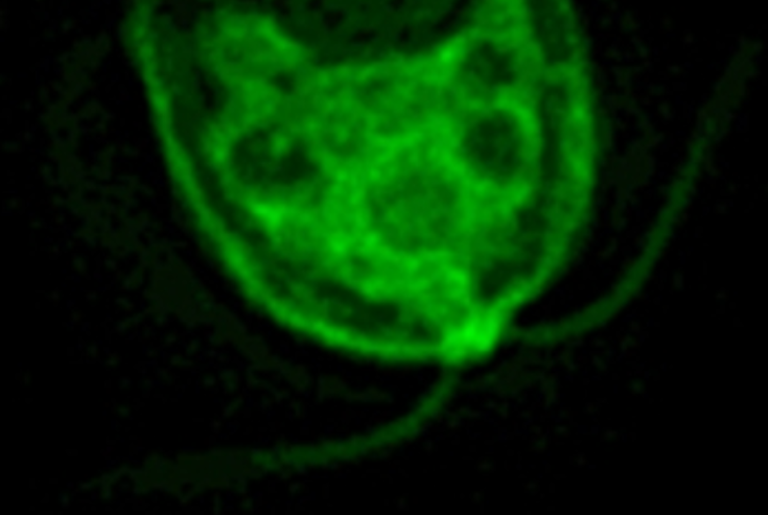
Some picoeukaryotes, such as Micromonas pusilla, can be grown in pure culture, but so far most cannot. Even when they cannot be cultured, we know they are there thanks to fluorescence and electron microscopy, flow cytometry, and metagenomic analysis. Several of these organisms appeared ideal for use as model systems and thus are being intensively investigated. O. tauri is one of those whose genomes have already been sequenced. Befitting its size, it has a small and very compact genome. Its 8000 or so genes make up a hefty 82% of its 12.5 Mb genome. To date, O. tauri also has the distinction of being the only eukaryotic cell that has been observed in its entirety by electron cryotomography.

Epifluorescence microscopy of Cyanidioschyzon merolae 10D. Red = auto-fluorescence due to chlorophyll; blue=DAPI-staining of DNA. Source
We have previously mentioned Cyanidioschyzon merolae in these pages. This has been the organism of choice for studying how single organelles in a cell are replicated and then accurately distributed to the daughter cells upon cell division. It turns out that its single mitochondrion becomes attached to the mitotic spindle! Another startling finding is that some of its tRNA genes are circularly permuted, as are the genomes of some phages. But C. merolae does it differently, their halves being in a backward orientation with the 3' half of the gene being upstream of the 5' one.
Picoeukaryotes are among the most abundant of our fellow travelers on this planet. They deserve our attention.



What a great post, Elio! I'm amazed that nobody else has commented. Keep up the good work — essays such as this help make the world of microbiology accessible to non-scientists.
I continue to think a "view meter" or "hit meter" would be a good thing. My guess is that many, many people read these essays and do not post responses.
Textbooks are great. Journal articles are fantastic. Meetings are wonderful. But I learn new things with the majority of the essays that Elio and Merry research and post at this blog. It truly is a useful resource for researchers, educators, and laypeople interested in the microbial world around and within us.
Mark (and everyone else!),
Your kind words are always appreciated and so are your keen thoughts. Our software does let us track how many visits we have. The numbers are not huge-usually around 300–400 daily during the week-but certainly respectable. Given that our intended audience is people with some microbiology training and not the general public, we believe that the blog is read by a satisfying number of microbiologists. Those who subscribe via RSS feed and are not included in our count. Our impression, gleaned from informally, is that the blog is generally well received.
Here is what we ask other readers to consider:
1. Subscribe to the blog via the RSS feed. This way, you will get automatic notifications on the web page of your choice.
2. Please send us comments. We should get more of them. The blog is intended as your forum for ideas, suggestions, exchange of information, etc. Please see it as your own site.
3. For those of you who teach microbiology, use items from the blog for supplemental reading and academic enrichment. Use Talmudic Questions for exams, especially in advanced courses.
Merry and I send a lot of time on the blog. If you value it in any way, please consider some of the above suggestions. They will be greatly valued and warmly appreciated.
Elio
Dear Merry and Elio: I just thought it was important that other people knew how often STC was being accessed—Dr. Ayers' comment prompted me.
Talmudic questions are beloved and hated by students...because they bring together everything.
I like asking students on the first day to describe "prokaryotic activity in the biosphere."
Then I ask it again at the end of the course.
It's all about the Prokaryotic Pride (with apologies to Norm Pace, yet again).
A 290 Mb genome wouldn't qualify such a species the distinction of having the largest known genome– for instance, the human genome is about 300 Mb. Doing some google research, the actual number appears to be 6.7*10^2 Mb.
Dunbar, we should have said "one of the largest microbial genomes." Thanks for the comment.
Elio
I think your 2nd figure does not show a Cyanidioschyzon cell tomography but rather an Ostreococcus cell. BTW, great post, as usual!