
Talmudic Question #29

by Bob Murray
What is the life expectancy for the descendants of a single bacterial cell under ideal or stressful conditions?
by Bob Murray
What is the life expectancy for the descendants of a single bacterial cell under ideal or stressful conditions?
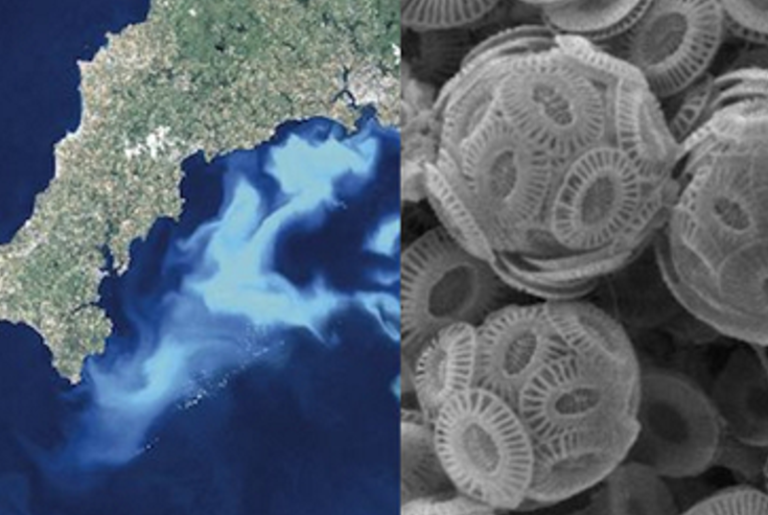
by Elio — In the ocean, bacteria and eukaryotic microbes (mainly the phytoplankton) interact in various ways, some mutually beneficial, others detrimental. Many, perhaps most of these interactions, take place via chemical communications. If you had a hydro phone-like gadget that could detect chemicals instead of sound, the racket would be deafening. Yet, we know little about these goings-on.

(Thanks To Mushroom Spores, That Is) by Elio — I have two purposes in discussing a recent paper from the lab of mycologist Nik Money. One is to present a notion of the way mushroom spores may contribute significantly to rain making. The other one is introduce a noteworthy wrinkle in electron microscopy...

by S. Marvin Friedman — Thanks to the extensive research of the past ten years, we've become aware that many prokaryotic endosymbionts and habitual intracellular pathogens have undergone genome reduction over evolutionary time. Characteristic of this process, termed reductive convergent evolution, is the discarding of genes involved in metabolic pathways and regulatory functions that have…

by Elio — I can't think of anything more startling, more promising, and more intractable in biology than the business of endogenous retroviruses. They seem to be ubiquitous in both invertebrates and vertebrates, and even in plants. In humans, they make up at least 8% of the genome, plus some bits and…

by Elio — Life without air – a term coined by Louis Pasteur, the discoverer of anaerobiosis – has been thought to be exclusively a property of microbes, be they prokaryotic or eukaryotic. Multicellular organisms were thought to lack this talent. Until recently that is, when an Italian and Danish group led by Roberto Danovaro looked at an unusual-sounding habitat...

by Elio — Ah, truffles! They are the gourmet's celebration, the cook's inspiration, the common man's anticipation. And they demand quite a price, which at last count hovered around $2000 a pound for Italian white truffles, the French black truffles being cheaper, but still not within the reach of most people. And their production…
Until the next autoclaving?
stan zahler
We have posted a note on this topic previously. See http://schaechter.asmblog.org/schaechter/2007/10/do-bacteria-age.html We are revisiting it because we keep finding it fascinating.
Elio
http://www.gsajournals.org/pdf/online_forum/i0091-7613–31-6-e93.pdf?SESSID=e083a186acecd0641c10fbab0b90e80f
250 million year nap for a halophile?
Maybe there is good reason to think that not every cell has the same life expectancy now that it has been found that there can be special survivor cells in a culture exxposed to starvation. Also many simple stresses lead to increase in the basic mutation rate and some of these may have physiological consequences. Might bacteria have their own version of apoptosis given that they have to live, most of them, in consortia somewhat like a tissue. A long ago experiment with a large Spirillum showed that about one in twennty five cells aither grew differeently of gave up after a division or two, Life can be tough for all folks biig or small.
There can be unexpected perturbations in what appear to be natural steady states. A case in point is provided by Beninca et al.,(Nature, 14 Feb 2008)who report the maintenance of a plankton community for eight years which established an effective food web under constant external conditions. However, fluctuations in the population of individual species appeared randomly over several orders of magnitude. Steady states were for only 15 to 30 days (the authors liken this predictability to weather reports!).Many causes of perturbation are possible but not least is a different level of chaos developed in individual members of the food web due mutations, distorted communications, and awakened lysogeny to list few of many possibilities. Again, there is no guarantee that the cells of a clone have equal life or physiological expectancies. Chaos, like entropy, is always with us.
Well, wouldn't it depend on whether or not endospores are considered progeny? If endospores are progeny, and the bacterium produces endospores, then the "progeny" of this one single bacterium can survive for centuries! (Especially if it is encrusted in amber and then germinated 500 years in the future.)