
Pathogen On Board (River Blindness)
by Elio
River blindness is a dreadful disease – the leading cause of blindness in tropical areas of the world. Its effects devastate the lives of entire villages. It has long been associated with infection by the filarial nematode, Onchocerca volvulus. The scarring of the cornea that leads to blindness was assumed to be caused by the inflammatory response to the worms. But the story turned out to be more intricate.
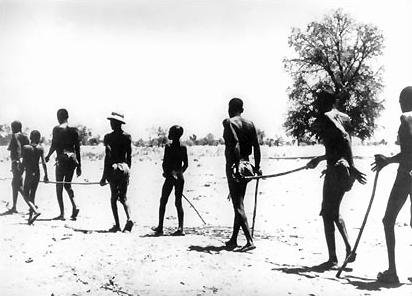
Row of blind men led by children. Source: BBC
The worm hosts a bacterial endosymbiont, one of the ubiquitous wolbachias. Wolbachia are very good at being endosymbionts. They are found among many invertebrates, especially insects, where they can induce parthenogenesis and other alterations of sexual differentiation. (This is a story that we promise to revisit.) In some filarias, including the ones we are talking about here, the Wolbachia reside in the female reproductive tract and are essential for reproduction of the worms. Other types of filarias, including the pathogenic Loa loa, appear to get along without them.
New evidence suggests that, with regards to river blindness, the worm is an innocent bystander, that the real culprit is the Wolbachia onboard. In a mouse model, bacteria-free worms don't cause disease, whereas those that carry Wolbachia do. Furthermore, Wolbachia inside living nematodes don't cause disease, either. Witness the fact that adult filarias can live in a human host for as long as 14 years without causing much damage. But when the worms die and the bacteria are released, damage ensues. Treatment with drugs that kill the worms results in fever and other signs of acute inflammation.
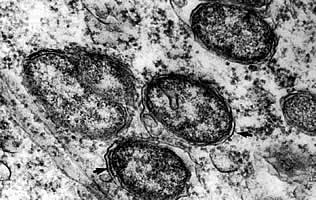
Wolbachia sp. in ovarium cells of a cherry fruit fly. Source: MicrobeWiki. Photo by S. Bluemel
It's thought that the inflammation response is caused by an endotoxin-like compound in the Wolbachia. The reason for the uncertainty is that sequencing of the genome of another Wolbachia (also an endosymbiont of a pathogenic nematode) tells us that the endosymbiont lacks some 20 of the genes needed for lipopolysaccharide (endotoxin) synthesis. (As has been the case with other endosymbiotic bacteria, this genome sequence is especially interesting.) Nevertheless, there are several lines of evidence that point to something in Wolbachia that has endotoxin-like activity. For example, mice with decreased sensitivity to LPS (C3H/HeJ) are less responsive to Wolbachia extracts. In addition, it has been found that the injection of Wolbachia extracts leads to a rise in toll-like receptors that are involved in the inflammatory response. Clearly, river blindness results from the immune response to the worm's endosymbiont, but more details need to be uncovered before we understand just how Wolbachia causes damage to its host's host. Putting all this together, it follows that the disease can be treated, at least in part, using antibacterial therapy.
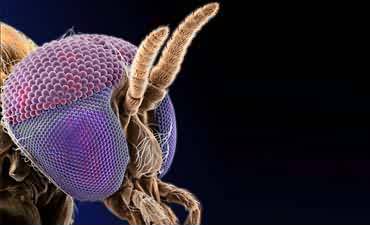
Head of simulian black fly, the insect vector for filarias. Source: Natural History Museum, London
Filarias cause not only river blindness, but also elephantiasis and other diseases that affect some 200 million people worldwide, bringing untold misery. The prevention and treatment of these diseases has been given high priority. The World Health Organization has targeted the elimination of the nematodes in a number of countries. Since the worms are transmitted from host to host through the bite of a black fly, insecticides are used along with a worm-killing drug, ivermectin. Their strategy does not seem to include treatment with antibacterial drugs, but this may yet change. The elimination of filaria-caused diseases would be a major health accomplishment and would remove this source of misery from the lives of countless millions of people in the years ahead.
The Wolbachia-filaria partnership is the only instance we know of an endosymbiont being responsible for the observed pathogenicity of its host. Can you think of others? (For those in the know, the Xenorhabdus-nematode case does not involve an endosymbiont. More on that some other time.)


