
Wayward Locomotive
by Elio
Poor wand'ring one!
Though thou hast surely strayed...
—Pirates of Penzance by Gilbert and Sullivan
Mycoplasma have good press agents. They frequently make the news these days, often because they have the smallest genomes of any free-living organism and, mirabile dictu, because their genome has been transplanted into a willing "anucleate" recipient, creating the first "synthetic cell." You might think that small means simple, but not so. Qualities of these organisms surpass their elephantine brethren in both complexity and fascination. Here is but one example of mycoplasmal ascendancy...

EM of a section through M. pneumoniae showing a terminal organelle. Source: Atlas, R. M. Principles of Microbiology, 2nd Ed.
Some mycoplasmas, such as M. pneumoniae, move by gliding, using a mechanism that may well be unique to this group of organisms. At the leading end of the cell, they have a complex structure termed the terminal organelle that is involved not only in motility, but also in cell adherence and even cell division.
The authors of a recent report, B. M. Hasselbring and D. C. Krause, made mutants that have a weak connection between the terminal organelle and the parent cell. This allows the terminal organelle to break off. As you might expect, the cell is rendered immobile, but remarkably the detached organelle goes its own way and continues to move for about a half hour! This demonstrates convincingly that the organelle is indeed responsible for motility, acting, in the words of commentator Grant Jensen, like a dog pulling a sled.
Normally, when a gliding cell encounters another cell, it is slowed a bit by the cell-to-cell contact but continues moving forward. Not so with these mutants. When a mutant glider is slowed by contact with another cell, the terminal organelle keeps on going at full speed, stretching the cell body into a thin thread which finally snaps, liberating the organelle.
A few more details. No DNA was found in the roving structures, but three proteins known to be localized in the terminal organelle were. A protein that is localized at the base of the organelle, P41, was found to have been altered in these mutants. Being able to isolate the organelle should facilitate study of its component parts and lead, eventually, to understanding how it works.
There is more here to hold our attention. When deprived of its terminal organelle, the immobilized cell makes one anew at the pole – except for P41 mutants who make them laterally, that is., in the wrong location. So, even organelle localization can be studied in this system. In his commentary, Jensen gives five other reasons why this story is deserving of attention.
In my youth, Mycoplasma were considered an oddball curiosity. If one could, one might as well set them aside. Even their name was wrong: myco? Their claims to fame were that they lacked a cell wall, some of them contained sterols, they contaminated tissue cultures (because they passed through filters used to sterilize the media), and they caused strange diseases, such as "atypical" pneumonia (what could be more pejorative than to be dismissed as the agent of something atypical?). Times have changed. They are now at the forefront of synthetic biology, genomics, and, soon, nanoengineering.

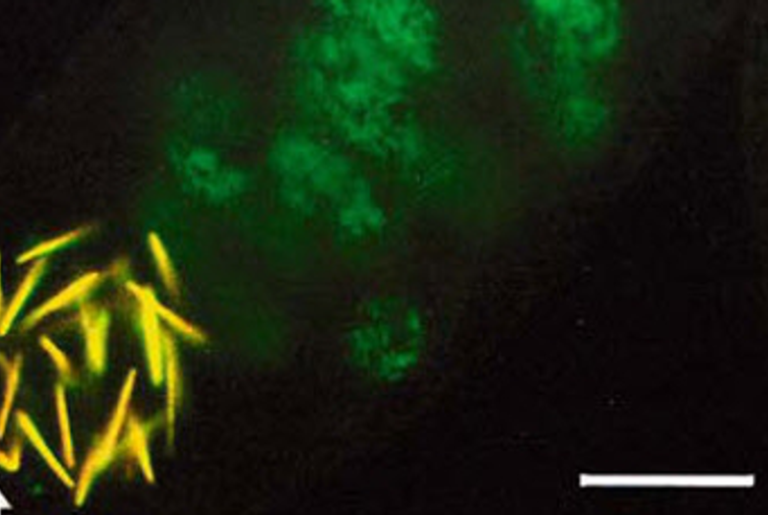


That movie was fan-tastic. Snap and zoom—a runaway engine leaving the rest of the train behind! For me, I only have *one* microbiology course and thus only have the single opportunity to introduce microbial concepts to students (the problem is large, as when a colleague of mine once told me that microbiology was *not* an organismal science). Visual media sometimes has much more of an impact than dry lecturing. So you can rest assured that I will be showing that movie in class either tomorrow or Friday.
There are many, many mysteries in motility. This terminal organelle at least makes thematic sense to me. But what about Brahamsha's swm mutations in Synechococcus?
J. McCarren and B. Brahamsha. (2007). "SwmB, a 1.12-Megadalton Protein That Is Required for Nonflagellar Swimming Motility in Synechococcus." J. Bacteriol. 189: 1158 — 1162.
This is one the best reasons to be a microbiologist today—to find out what the heck is going on with some of the microbes all around us.
Thanks for the thought-provoker. This one goes in the same file was Katrina Forest's great article about alternative forms of surface motility:
Merz A.J., and K.T. Forest. (2002). "Bacterial surface motility: slime trails, grappling hooks, and nozzles." Curr. Biol. 12: R297 — 303.
Mark,
Thanks for amplifying on the marvels of bacterial motility. One could go on and on and still not run out of fascinating examples.
Elio
thanks for pointing this analysis out. and thanks for your viewpoints and further questions. I enjoy learning how to ask the right questions.