
A Bacterial Mouth
Guest author Mark O. Martin
I have really been enjoying reading this blog over the past few months. Not only is this type of blog of interest to students and microbiological mavens, but the articles and the comments sometimes bring up prokaryotic nuggets not easily found in the literature! Thus, I appreciate the opportunity that Elio and Merry have extended to me, to tell a weird and wonderful microbiological tale.
This tale begins with Elio's Talmudic Question #3: Why are no bacterial pathogens known to use a Bdellovibrio-type of mechanism to penetrate into eukaryotic cells? Since I have done a little work with predatory prokaryotes, this subject particularly interests me. We are only now starting to understand how Bdellovibrio obtains entry into that enigmatic compartment of Gram-negative cells, the periplasm. Type IV pili have been implicated by a recent publication from Liz Sockett's group in the UK. The periplasm is quite a unique place (see this recommended book by Ehrmann), full of osmotic challenges and diverse solutes, with a gel-like consistency. (At an ASM meeting many years ago, Terry Beveridge of the University of Guelph chided me for saying "periplasmic space" instead of "periplasm" for that very reason.)
Eukaryotic cells do not possess a periplasm, so the simplest way to answer Elio's question may be to state that there is no need for a Bdellovibrio-like mechanism. Instead, pathogens and symbionts hijack the mechanisms that eukaryotic cells use to internalize materials from their surroundings: phagocytosis and pinocytosis. So I would turn Elio's question around with a not-quite Talmudic reply: why do prokaryotes not have phagocytosis or pinocytosis? This lead us to a seemingly bizarre question: can a bacterium have a "mouth"?
Many bacteria consume long polymers, such as cellulose or chitin. One strategy used by gliding bacteria of the Cytophaga/Flavobacteria group is to attach themselves to these polymers and secrete enzymes that release monomers or small oligomers. The fragments are then transported into the bacterial cytoplasm and further metabolized. One problem with this approach is that the importable fragments are available to other microbes, not just the organisms doing the "work." Diffusion works against these polymer-degrading organisms, as well.

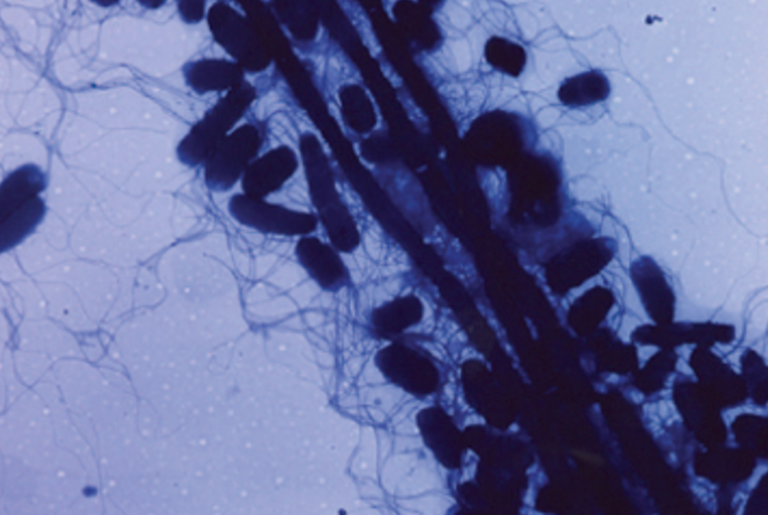
Electron micrographs of Sphingomonas strain A1 in the absence (left) and presence (right) of alginate. Source
This prompted me to recall a presentation I attended several years ago at ASMCUE by Julian Davies of the University of British Columbia. Julian told us about, of all things, a "bacterial mouth." A Gram-negative bacterium, Sphingomonas sp. strain A1, does something a bit unexpected. In response to the presence of alginate, it synthesizes an alginate lyase to depolymerize the polymer. But the cell also synthesizes a "pit" on its surface, approximately 0.02 to 0.1μm in diameter. Only one pit is synthesized per cell, and it appears to be lined with ABC-type transporters specific for alginate-derived oligomers and monomers.
Take a moment and look at these electron micrographs. It certainly appears that, as Julian told us, Sphingomonas "opens" something like a "proto-mouth" in response to the alginate! Also, observe the model of the proto-mouth that the researchers postulate. This presents a solution to how a polymer can be broken down in an exclusive fashion: using a pit or proto-mouth linked to polymer degrading enzymes and an ABC transport system. The pit appears to concentrate the released oligomers, further reducing loss by diffusion.

Putative model of the pit formed by Sphingomonas sp. when dining on alginate. Source
If bacteria can have a "mouth," do they then "swallow"? Prokaryotes, it appears, don't have much of a vacuolar system. However, this discussion of a pit and proto-mouth leads to the possibility of evolution toward something like phagocytosis and pinocytosis (and might also help explain the genesis of "prokaryotes within prokaryotes"). There already is some evidence for this kind of internal structure in a less E. coli-centric world. Some planctomycetes do appear to have vacuole-like compartments which may be more "eukaryote-like" than gas vacuoles, magnetosomes, or carboxysomes.
So where are we, regarding the questions in this essay? It does look like some bacteria have a pit-like structure that could be called a primitive mouth. We may yet find processes that resemble phagocytosis among the prokaryotes. We should start looking, perhaps, among the cell wall-less bacteria and Archaea, which could conceivably form vacuoles by "engulfing" particles from the environment, much as eukaryotic amoebae do. Also keep in mind that the giant bacterium Epulopiscium, found in the gut of surgeonfish, has many, many invaginations of its cell membrane. Close off such an invagination, and a nutrient-rich vacuole could be created.
Stay tuned, and keep looking. In a nutrient rich gut, or a hot spring, or within a complex biofilm, I believe that some uniquely weird and wonderful prokaryotes are waiting to be discovered. Perhaps even ones with a "mouth" and "teeth"!
Source of Figures: Momma, K. et al. (2000) A Novel Bacterial ATP-Binding Cassette Transporter System That Allows Uptake of Macromolecules. J. Bacteriol. 182: 3998–4004




Along the same lines of what Mark discusses, Milt Saier made a great presentation at a Branch meeting in San Diego a number of years ago showing all kinds pictures of human physiology as it exists in bacteria; as I recall, Milt showed pictures of fingers, noses, etc., etc.. he also wrote a short article in " Microbiology" although this was more serious. You should ask him!
Thank you, Dr. Davies! You gave a great presentation. I never saw Milton's presentation, but I sure do want to ask him about it soonest!
Incidentally, Abigail Salyers did a nice review paper awhile back on this general topic of "large food items versus small consumer":
A A Salyers, A Reeves, and J D'Elia. (1996). "Solving the problem of how to eat something as big as yourself: Diverse bacterial strategies for degrading polysaccharides." Journal of Industrial Microbiology and Biotechnology 17: 470 – 476.
So interesting! Yes, I imagine there is plenty out there to discover about prokaryotes that no one has even thought to look for.. These thoughts made me recall something that always puzzled me. As Mark describes, bacteria certainly do break down polymers in order to take them in for metabolism. The standard line on this is, they break them down into 'small enough monomers to absorb.' But, we know that many bacteria have the ability to take in DNA for purposes of transformation.. and these pieces must be rather large, since entire genes do get recombined. So clearly, the mechanism for intake of polymers already exists and is quite elaborate. Why not take in other polymers as well? I would imagine that selective pressue for this sort of polymer uptake rather than use of secreted exoenzymes might be in a competitive environment where polymers are the only source of energy and excretion of exoenzymes might not be the best strategy...