
Talmudic Question #20

If viruses did not exist, could anyone have conjured them up?
If viruses did not exist, could anyone have conjured them up?

by Elio — In the celebrated novel 'The Rebel Angels', the famed Canadian author Robertson Davies mentions Ozias Froats, a fictional professor potentially on his way to a Nobel Prize for discovering that everyone's feces reflect the maker's personality. He did not have today's ready recourse to metagenomics (that being still in the future)…
by Roberto — Read the following two phrases:
∙ In the presence of lactose, E. coli induces beta–galactosidase in order to use the sugar.
∙ In the presence of lactose, E. coli induces beta–galactosidase and thereby uses the sugar.
Which one would you use? Do you see the fundamental difference between them?

what is the leading cause of bacterial or archaeal death?
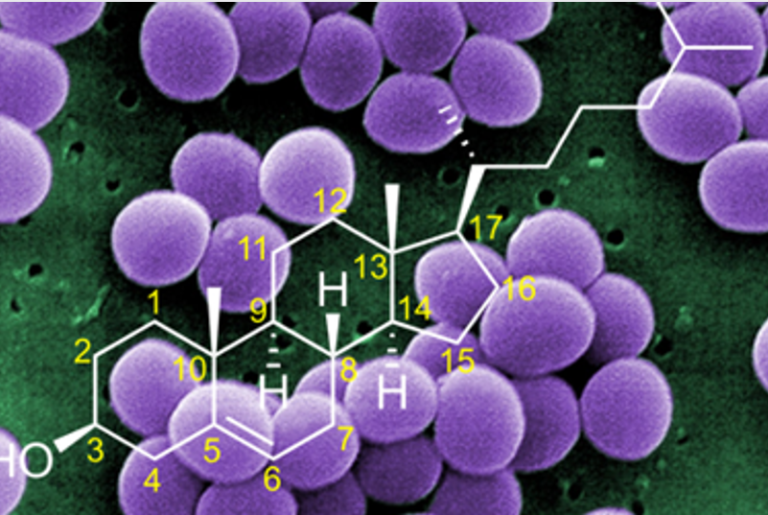
by Elio — Cholesterol and MRSAs vie for headlines. Both are formidable topics of enormous interest to readers of mass media and to scientists (many of whom read mass media, probably in the bathroom). It turns out that Staphylococcus aureus and arteriosclerosis have...

by Amy Cheng Vollmer — I have been teaching introductory biology in higher Ed since 1985, my first four years at Mills College and now at Swarthmore College since 1989. At both institutions, these courses (lecture + laboratory, taught by faculty members) were open to majors and non-majors. Through these years, it has been…
As NASA's hotshot exobiologist, you are asked to design an Earth satellite system in which some organism(s) can live actively (i.e.. no spores) for millennia. How would you go about it? Specify an orbit of your choice.
If viruses didn't exist, could there be anyone to do the conjuring?
Viruses, viroids, virinos, and then the whole can of worms that we call prions.
Which came first, the viral chicken or cryptic prophage egg? One thing that needs to be remembered is the "gene transfer agent" found in relatives of Rhodobacter:
Andrew S. Lang and J. T. Beatty (2000). "Genetic analysis of a bacterial genetic exchange element: The gene transfer agent of Rhodobacter capsulatus." Proc. Natl. Acad. Sci. USA. Vol. 97: 859–864.
Or look at phage Mu for that matter: transposon and phage at the same time.
So did a bunch of genes get together and "go feral," creating a phage, or are things like GTA really "degenerate" phages. The authors think the latter. I suspect that, the more we look deeply, the more we will find a broad spectrum of associations. But were their phages "in the beginning"? Tough to say.
Certainly Woese's "pre-Darwin" view of early cells is predicated on frequent and efficient gene exchange.
I think viruses would arise naturally from transposons and the like, without the need for human intervention. Bacteriophages could arise from mildly infectious 'naked' DNA. Since all the machinery (DNA polymerase, ribosomes, metabolism) is in place, cheaters (like viruses) will inevitably develop.
Funny, Merry! Apologies to all for my lack of proofreading in my earlier message. Transposable elements often pick up genes of unrelated functions. Why not genes that confer some extracellular viability and ability to enter new cells? This may be what happened to phage Mu? On the other hand, there is some evidence for very, very large viruses with complex "biochemistries," like the mimiviruses. Such "megaviruses" could be streamlined into conventional phages....
And as Josh Nahum suggests, perhaps a capsid coat is not necessary—given how frequent transformation may well be in nature!
This all reminds me of the "Selfish DNA" debates in the 1980s....
A lively discussion (not surprising!)
I was initially confused by the TQ (also not surprising!), because I couldn't conceive of a virus-free living world. Mark put it quite well earlier, so I won't repeat him. Viral life must have arisen very quickly. I imagine membrane bound RNA with enzymatic replicative function quickly parasitized by RNA's that get copied with them and enclosed in the same membrane (I recently read a SciAm article suggesting nucleic acid free protolife, but let's stick with a 'standard model'). Thus a "genome" grows. Soon another protogene arises that can insert and/or excise itself from a strand, and the first protophage is born. I can't imagine that RNA based life was around for very long before a virus/transposon started to parasitize it. The fact that there are no replicative cells with RNA genomes but there are lots of bacteriophage and viruses with RNA genomes suggests a possible early rise of viral lifestyle to me, although perhaps that is naive.
I'd have to agree with the musing that the first viruses evolved from mobile genetic elements–transposons and the like. The chance landing of the element near genes encoding replicative machinery and/or capsid-like proteins (the "metabolosome" shell proteins described for ethanolamine or 1,2‑propanediol catabolism; and "carboxysome" shell proteins used by photosynthetic microbes for concentrating CO2) would provide at least some of the components for a crude virus/phage. Hopping around the chromosome would help to acquire other needed components. Subsequent refinement through evolution could make the viruses into the critters we see today.
Say...what about those strange membrane vesicles or blebs from Pseudomonas aeruginosa that have been demonstrated to carry genetic material between bacterial cells?
Renelli M, Matias V, Lo RY, Beveridge TJ. (2004). "DNA-containing membrane vesicles of Pseudomonas aeruginosa PAO1 and their genetic transformation potential." Microbiology. 150:2161–2169.
This is a very cool paper, and I wonder if others have followed up on it. No capsid proteins needed there! All a transposable element needs to do is somehow get itself located at the site of "bleb" formation!
Such a mechanism would make the evolution of "viruses" much easier!
Interesting question and superb answers so I'll try it from a different angle: suppose that viruses don't exist or we don't know of them, could we predict (conjure) the nature of viruses? Most top down viewpoints on life examine biological organization going from independent cells towards either hypothetical protocells or parasitic/symbiotic states. The mitochondrion would be the 'minimal' remnant of a cell. This orientation is natural, we are curious as to how cellular life evolved and hypotheses have been made on what a primitive or early cell might be like; these ideas are at least partly based on studying minimal cellular life or symbiotic organelles. The primitive life predicted from this standpoint might have a membrane and either metabolism or replication but wouldn't look like a virus or phage.
Therefore, if we hadn't found and understood viruses, it would be likely that we never would have guessed what they are like simply because viruses aren't the predicted minimal cellular life but something very different. A surprise, in other words, that was found as early as it was because of the diseases caused by viruses.
Thus, suppose that we didn't know about biological viruses but the computer age still happened. Would computer viruses have been invented? If so, would this have led to a prediction that biological analogues of computer viruses existed? Perhaps that is yet another Talmudic question.