
Talmudic Question #3

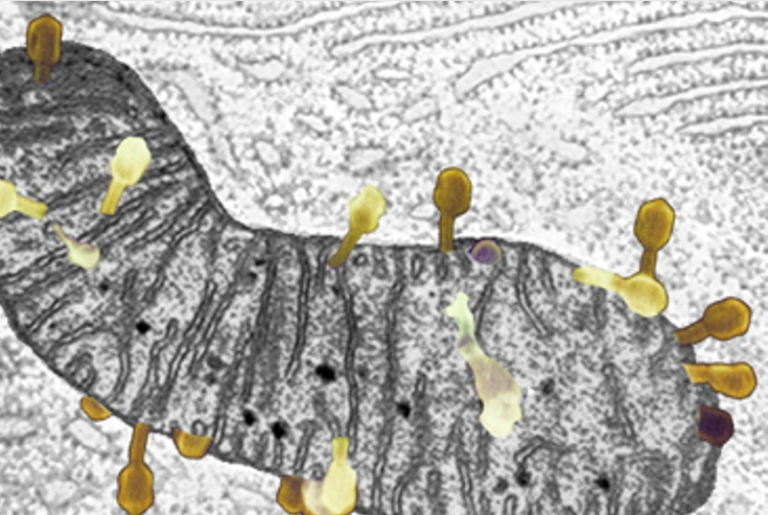
Why are no bacterial pathogens known to use a Bdellovibrio-type of mechanism to penetrate into eukaryotic cells?
Why are no bacterial pathogens known to use a Bdellovibrio-type of mechanism to penetrate into eukaryotic cells?

by Elio — In a recent Opinion piece in 'Trends in Microbiology', Gemma Reguera invites us to think outside the box. The box in question harbors the notion that communication between microbes is chemical, and only chemical. Here, the author cuts through the confines of this perspective to point out that microbial communication also takes…
We posted Talmudic Questions #118 and #119 together because they struck us as being inter-related, both sending our thoughts down similar avenues. Their appearance together on the blog prompted a lively conversation that we thought too interesting to leave buried out of sight. Moreover, we note that it is not too late to take part by posting a comment. You don't have to be an expert to contribute a comment here, or on any of our posts. We invite you to join in...

by Christoph — If you've ever come across the topic of 'gene regulation in bacteria' in your biology classes at high school, college or university, you've inevitably learned about a classic: the lac operon of E. coli. Well, this it's not an exam here! Just ask yourself what you remember without the help of an AI.

by Rachel Sidebottom — With the successful launch of the Crew Dragon by SpaceX, space exploration is once again in the American spotlight. Outside our planet, space is unconducive to life because of conditions created by cosmic radiation and microgravity.

by Roberto — More than fifty years ago, towards the end of Spring term in May 1971, university campuses across the U.S. were rife with protests over the Vietnam war. Students skipped classes and left labs to participate in marches and sit-ins. In addition, the memory of Woodstock (August 1969) was still fresh in everyone's mind.

by Christoph Weigel — In prokaryotes, it only takes a small jazz band to get the music grooving: piano and a rhythm section suffice. The promoter region of a gene is a tiny stage on which RNA polymerase ℗ and few transcription factors (dr, b) improvise on a tune, i.e. they initiate or skip transcription. By contrast, it takes a big band in eukaryotes to perform Duke Ellington's 'Caravan'. And since not all the musicians...
Bdellovibrio only penetrate cell wall and occupy the periplasm. How they accomplish extraction of all they want from the cytoplasm through the membrane is probably largely due to autodestruction of macromolecules giving usable products. Pathogens often become attached to surfaces of animal and plant cells having gained entry to tissues presumbly via receptors and enzymic attack, or by toxic poisoning of barrier cells. We always seem to assume that nutrition is looked after by the content of tissue fluids but in cases where toxic effects cause cells to leak, then the process is Bdello-like. Someone must know more about free-living eucaryotes and protists, who also get invaded and parasitized.
So, if the Bdellovibrio stays only in the periplasm, that's the answer, right? Eukaryotes, as far as we know, don't have periplasms. So, wouldn't the next question be, if eukaryotes were to develop periplasms, how long would it take for Bdellovibrio to mutate to infect Eukaryotes?
Autumn,
Clever answer, but is there no law that says that bacterial parasites MUST live in the periplasm? Bdellovibrio sure does but there are some that don't.
Elio
Aha! And that's where the "Bdello-type mechanism" comes in! Duh! Um, let's see... ... ... ... ...
Well, could it possibly be because of the different structure of the plasma membrane of eukaryotic cells? May be bacteria haven't developed enzymes to break down the double-layer of phospholipids yet!