SIMPLIFY Science Writing
by Roberto
Writing is an essential part of all scientific endeavors. Yet it is rare to find a scientist that finds it easy, not to mention joyful. I am not much different. But after many years at it, I have learned to take certain steps that make the process at least less daunting, even simple. I dare say, sometimes it's lots of fun. Believing that some readers may find it useful, here's my unsolicited advice.
A while back, while preparing for a lecture on the topic, I dreamt up the SIMPLIFY acronym to encapsulate my approach to writing.
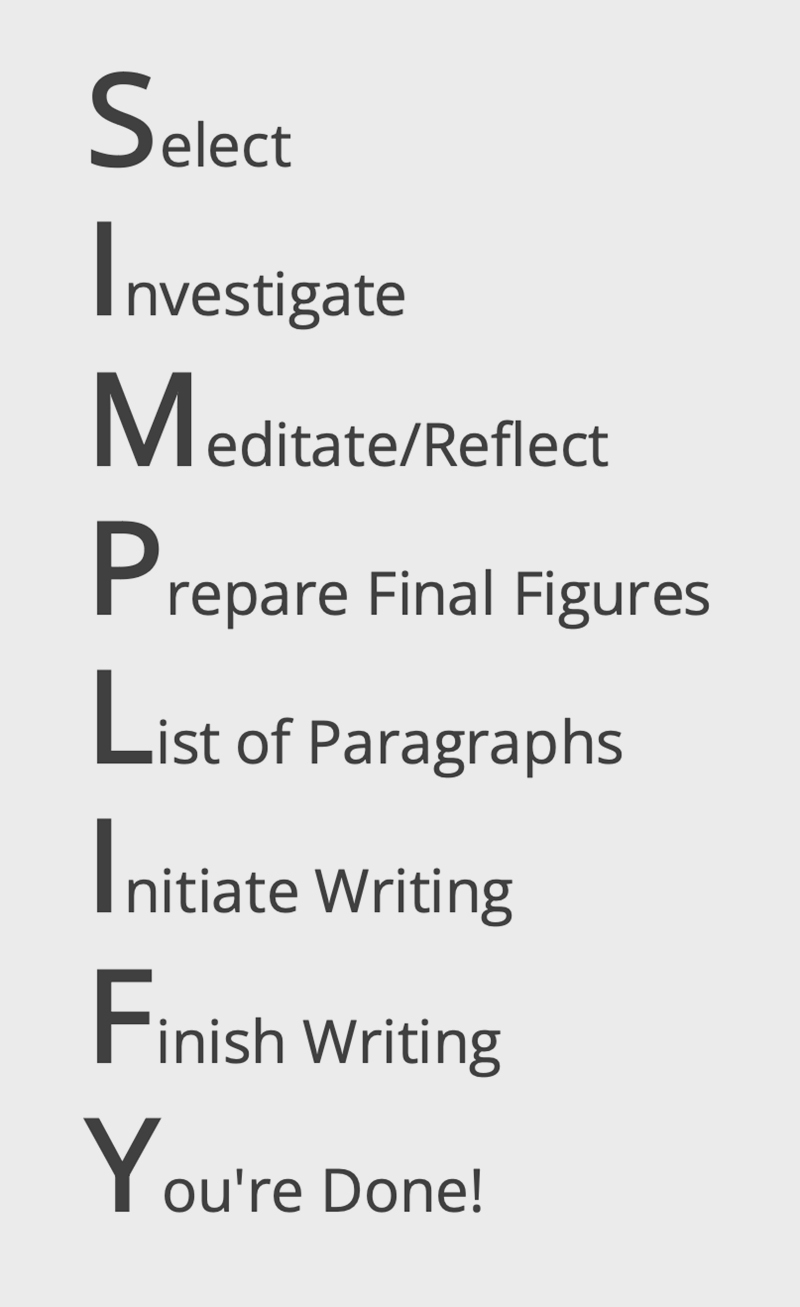
Select. At STC we are constantly on the search for topics we'd like to write about. Once we identify a subject, we routinely discuss it amongst ourselves. Having a ready-made list makes topic selection "a piece of cake." The effort is in the preparation of the list. For a someone at the early stages of writing a research paper, the selection process is already focused on the results at hand. Yet, an important starting place is the selection of the order of how the results at hand should be presented to best communicate them to a naive audience. This works best if done by discussion not only with co-authors but, importantly, with friends/colleagues not directly involved in the work. It is also at this stage when superfluous and/or lacking results are most easily identified. By the end of this stage, you will have a clear picture of the "storyline."
Investigate. Finding a new topic to write about gives me license to dive freely into the existing literature on the subject. So, I must exercise great restraint and know when it's time to stop and proceed. For a research paper, this is about making sure that you have read and understand all the relevant literature that allows you to place your work in the proper context; it's gathering the material you'll use mainly for your introduction and discussion. And, of course, in writing a review, this is the bulk of the work. It most certainly pays to keep short notes on (and easy access to) every item you determine is useful as soon as you find it.
Meditate/Reflect. This step, often overlooked, is critical. It's where most of my key ideas for text arise and I also find it the most enjoyable and rewarding stage in the process. Once I sense that the source material is ready after selecting and investigating, it's time to leave the laptop and internet behind and play with the material in my mind, unconstrained. I find that I best accomplish this during early morning runs or late afternoon walk (yes, with my dogs). This will vary for each person, but the key is to have reasonably long periods without distractions. This allows amorphous phrases or even entire paragraphs, to emerge in mind. There's no forcing them and don't expect any order. It's a playful and disorganized activity. If attractive parts of text arise, follow them, play with them, watch them evolve. You'll be able to go back to them later.
Prepare final figures. Then, it's time to begin focusing the activity. And there's no better way than to prepare figures (or tables or other such data presentation aids). Since I'm going to be putting effort into this, I prepare them all the way so that I feel they are in final format. While they might still change (and likely, they will), it's amazing how much clarity of thought is gained from preparing figures in their final format from this stage onwards. In blogging, the figures can be a bit like decorations. But in research articles, they are the foundation around which text will be written. The text is really writing about the figures. So, before you start writing, remember the final figures first. I like to say that with the figures ready, the paper will write itself. True, but not quite. You'll need an outline.
List of paragraphs. Having assembled all the material and with final figures on hand, it's time to bring order to my ideas. No better way to do this than to prepare an outline and no better outline than a list of paragraphs. In science writing paragraphs have a meaning, they contain a single well-developed concept. The first sentence of a paragraph presents that concept, so having a list of first sentences (even if rough at first) always proves invaluable in writing final text.
Initiate Writing. Now, finally, it's time to write. At this point it is fair that say that the piece will write itself. I also recognize that it is not always easy to get rolling. What helps me? No distractions: cell phone far away, I turn off the Wi-Fi on the laptop if further internet searching gets in the way of writing flow, and I set aside blocks of time when I'll be doing nothing else. What to do if no text comes out? I often will start writing nonsense and slowly begin directing it towards the list of paragraph-opening sentences. Before I realize it, I am finishing those paragraphs. No matter what I write, I make sure to write something every time I sit down to do it. I do take lots of short breaks. Not only are they important physically – stretch the body – they also allow me to go over text in my mind. Usually in less time than I had suffered it might take, the text is done. Or almost done.
Finish writing. Yes, there's the final editing phase. That's when I realize there's lots of odd sentences here and there, as well at the unpardonable typos and grammar mistakes. And then, of course, comes help from others. The final editing always includes at least one more set of eyes going over the text. So, make sure you always have a good friend and colleague willing to take on this task, and be ready to return the favor. Final edits can sometimes seem to take forever. So, it's incredibly useful to have deadlines! At STC we are fortunate, we must have posts ready to go every Monday and Thursday. Why? Completely self-imposed. But let me tell you, they work.
You're done! Not much more to say. I have finished this post and so, it's time for me to celebrate. And get some rest before I start writing again.
Do you want to comment on this post? We would be happy about it! Please send us an email, or comment on Mastodon, or on Bluesky.